
Playbook

Key Ideas
- We need digital transformation of teaching and learning at scale across the United States.
- The century-old one-size-fits-all approach to teaching and learning cannot account for the learner variability that exists among populations; educational technologies can pull us into more learner-centered constructs, accelerate learning, and help us close historic learning gaps.
- Technology is not a cure-all, but an enabler of powerful pedagogy. In turn, teachers need the human touch of professionals and policymakers to create coherent systems and an education ecosystem to support teaching and learning in the digital age.
“If it ain’t broke, break it.”
This phrase is often used in business to promote innovation—something that is integral for entities to succeed not just in the present, but in the decades to come. Through the years, the innovation of digital technologies has transformed entire industries. Now it’s time to put those technologies to use and apply that same mentality to transform our schools.
We need digital transformation of teaching and learning at scale across the United States.
Digital transformation can pull K-12 education into new learner-centered constructs that accelerate learning and help close historic gaps. Moreover, it will ensure that schools are prepared the next time a natural disaster or health crisis disrupts in-person learning.
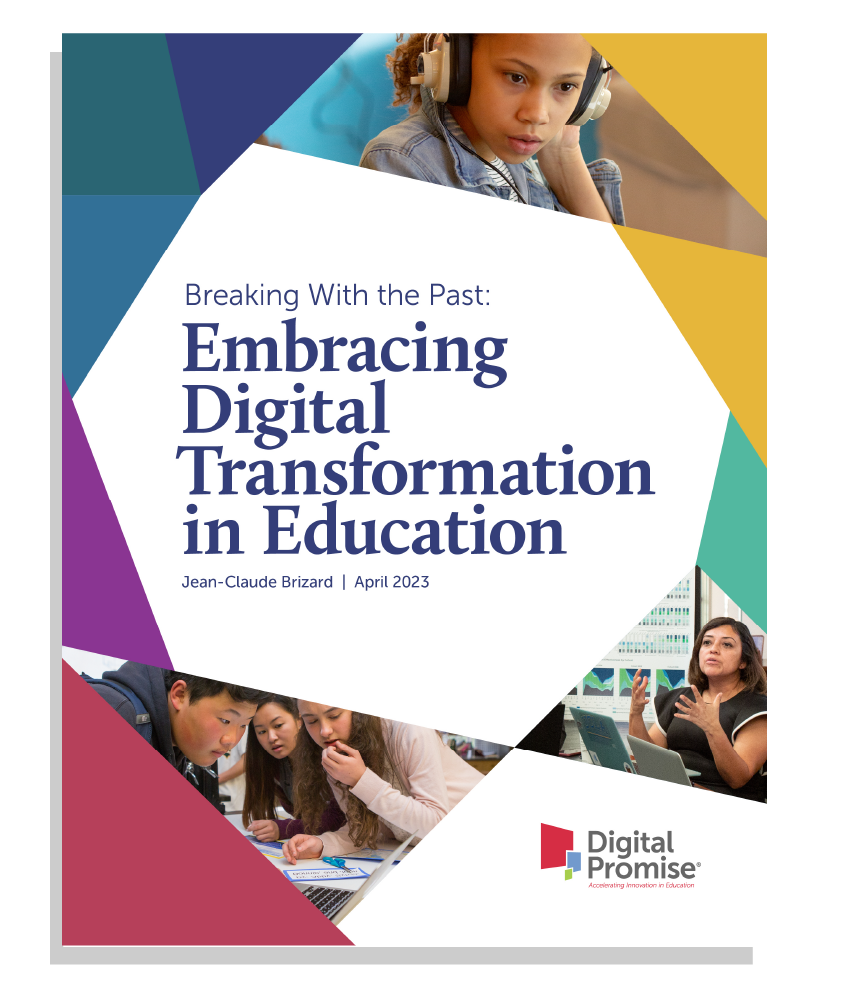
Our new white paper examines how the traditional one-size-fits-all approach to teaching and learning compares to more learner-centered, personalized, and motivating frameworks; why we need to transition to them at scale; and how digital technologies now enable that scaling—topics we take up in the first section of the publication.
Further, we hope readers leave the publication with an understanding of specific components of systems and the education ecosystem that we need to build out with coherence, coordination, and the participation of school districts, state agencies, philanthropies, and others to support and sustain digital transformation—a subject we explore in the publication’s second section.
This report is a companion to our recent publication, Delivering on the Promise of Digital Equity, which is designed to help state and local community leaders find effective ways for investing in K-12 education to increase digital equity.
While technology and access are critical pieces of a digital transformation—without digital equity, digital transformation cannot occur—true digital transformation takes more than technology; it requires building capacity, proficiency, and infrastructure, as well as shifting to a mindset that views technology not as a cure-all, but rather as a powerful enabler that fosters deep integration of relationships between the teacher, learner, content, and family.
Why we need the digital transformation of teaching and learning
The digital transformation of teaching and learning can pull us at greater scale into more effective learner-centered frameworks.
Students pay the greatest price with the centuries-old approach to teaching and learning, as many fail to reach grade-level proficiency at the pace expected of them. Fortunately, digital technologies now enable constructs for K-12 education that learning sciences tell us are more effective: those that are more personalized and focused on the demonstration of competencies, rather than the acquisition of seat time. Furthermore, teachers must have the skills and tools to tailor instruction to students’ knowledge and skills, cultural and family backgrounds, and individual interests and attitudes about their own abilities.
The nation’s learners can’t wait for many more tomorrows to come and go without a broad national commitment to breaking the outmoded framework for American education.
Jean-Claude Brizard
President and CEO, Digital Promise
The digital transformation of teaching and learning can provide schools with the means to more effectively address historic inequities in educational opportunity and close learning gaps.
Access to technology and high-speed internet is not enough to address educational inequities. The reality is that these technologies most benefit affluent, English-proficient, non-remedial, and white populations of learners. To address this, districts must intentionally harness the power of technology for learners who have been historically and systematically excluded.
The digital transformation of teaching and learning will better prepare us for future disruptions.
The COVID-19 pandemic exposed how inadequately prepared we were to deliver high-quality instruction to students in the digital age. The capacity for schools to evolve with and stay ahead of the technology curve is critical not only for facilitating digital transformation, but also for actually sustaining it.
The digital transformation of teaching and learning can pull systems and the educational ecosystem into new constructs.
Teachers cannot achieve this transformation on their own. They need the human touch of professionals and/or policymakers in state agencies, school districts, teacher preparation programs, philanthropy, and the nonprofit and edtech communities, who will create coordinated systems and an education ecosystem to support teaching and learning in the digital age.
Looking forward
The nation’s learners can’t wait for many more tomorrows to come and go without a broad national commitment to breaking the outmoded framework for American education and replacing it with frameworks that are more learner-centered, personalized, and effective. Digital technologies applied skillfully to teaching and learning might deliver on that possibility at long last.
Read our new white paper, Breaking With the Past: Embracing Digital Transformation in Education, to take a deeper dive into each of these concepts.
- Topics: Evidence-Based EdTech , Pathways and Economic Mobility , Systems and Leadership
- Learning Environments: K-12
- Audiences: EdTech Developers , Educators , Learners , Policymakers , Researchers , School and System Leaders
- Offerings: Credentialing , EdTech Strategy and Standards , Partnerships , Practice and Professional Learning
- Programs: League of Innovative Schools , Learner Variability Project , Micro-credentials , Product Certifications , Verizon Innovative Learning Schools