
Key Ideas
- Our Hearing Each Other’s Voices (HEOV) project brings researchers and practitioners together to create resources grounded in both evidence and the realities of practice.
- Research-practice briefs turn locally grounded learning into ideas and strategies that practitioners can adapt.
- Sustained collaboration helps researchers and practitioners better understand one another’s expertise, contexts, and perspectives, building relationships that can support continued learning and collaboration.
Let’s be honest: researchers and practitioners are both trying to improve learning, but sometimes it can feel like we’re speaking different languages. Researchers might be thinking about evidence, findings, and implications, while practitioners might be thinking, “What does this look like when I have 30 minutes and three other things on my plate?” Neither perspective is wrong. In fact, both are necessary. The challenge is creating meaningful opportunities for those perspectives to meet.
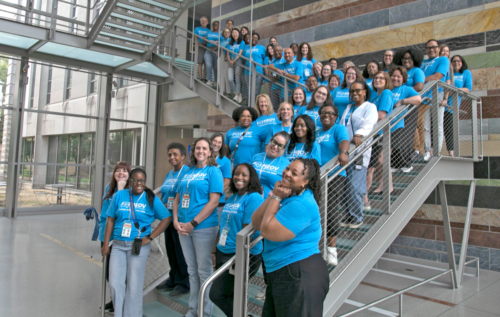
This dilemma is at the heart of Hearing Each Other’s Voices (HEOV), a project designed to bring STEM instructional coaches and educational researchers into sustained collaboration around real challenges in K-12 education. After months of conversations, learning, drafting, feedback, school visits, and more conversations, we’re excited to share the research-practice briefs (RPBs) that grew from this work.
Translating Research into Practice
An RPB is a research-informed resource designed with the realities of practice in mind. Each brief takes research related to a real-world challenge in teaching and learning and brings it into a format that practitioners can actually use. Rather than asking practitioners to figure out how research findings might apply to their context, RPBs bring together:
- Practical context connected to everyday teaching and learning
- Research-based insights that help explain the problem of practice
- Actionable strategies that educators can adapt
- Tools and guidance to support implementation
Most importantly, these briefs aren’t simply research summaries written for practitioners. They were developed collaboratively by researchers and practitioners who spent time getting to know one another’s work, experiences, questions, and contexts.
At its core, the HEOV project is interested in answering the question: How can we make research more useful—and make practice more visible—to one another?
Starting with the Problem
Teachers and instructional coaches have a plethora of knowledge about student needs, district expectations, available technology, and professional learning structures. Our process began with a practitioner-identified problem or possibility of practice that they wanted to better understand, address, or improve—such as how to meaningfully integrate technology into instruction or approach an aspect of teaching more effectively. These were problems identified by teachers and coaches based on the day-to-day realities of working with students.
Researchers were then connected with practitioners based on shared areas of interest and expertise. Researchers bring deep knowledge of evidence, theory, methods, and what the broader body of research can tell us about a particular challenge. Together, researchers and practitioners explored the problem, examined relevant research, considered the local context, and thought about what might be useful to educators. The collaboration culminated in a writing intensive where partners came together to turn their conversation and learning into a shared product.
Where Research Meets Practice: Bridging Knowledge through Collaboration
At its core, the HEOV project is interested in answering the question: How can we make research more useful—and make practice more visible—to one another? When researchers have opportunities to understand the context in which practitioners work, they can ask better questions about how their work might be applied. When practitioners have opportunities to engage directly with research and researchers, they can access evidence that may help them think differently about challenges they are already navigating. And when they create something together, the resulting resource has the potential to travel beyond the original partnership.
While problems of practice are deeply shaped by local contexts, they are rarely unique to a single school or community. RPBs are designed so that educators facing similar challenges can adapt the insights and strategies to fit their own context, allowing what may be the end of one partnership’s conversation to become the beginning of another’s. Because practitioners have a hand in creating these resources, they carry the added credibility of being informed not only by research, but by the realities of practice.
We invite practitioners to explore the briefs with a single question in mind: Could this help me think about a challenge I’m working on? And we invite researchers to read them with a separate question in mind: What might I learn about how research becomes useful when it meets practice? Bridging the research-practice gap isn’t about pushing knowledge from one side of the gap to the other, but creating enough space for both sides to hear each other’s voices, and build something together.
Explore the HEOV Research-Practice Briefs
See what happens when research and practice come together to address real questions from real educational settings.
This material is supported by National Science Foundation awards 2300618 and 2300619. Any opinions, findings, conclusions, or recommendations are those of the authors and do not necessarily reflect the views of NSF.
- Topics: AI and Emerging Tech , Classroom Practice , Core Content , Evidence-Based EdTech , STEM/STEAM
- Learning Environments: K-12
- Audiences: Educators , Learners , Researchers
- Offerings: Co-design , Practice and Professional Learning , Research and Development
- Programs: Learning Sciences Research