
Curriculum
Key Ideas
- Spatial skills, such as using spatial language, navigating using landmarks, and understanding maps are important for future success in math and are found to support learning broadly.
- The Spatial Orientation Assessment Task (SOAT) is a research-based assessment tool that measures young children’s visual spatial skills through playful, engaging activities using toys and maps.
- SOAT is carefully designed to be fun, inclusive, and accessible for preschoolers while allowing them to demonstrate understanding through language, gestures, and movement.
Following directions to a friend’s house or interpreting how the app on your phone guides you from point A to point B are skills we need to successfully navigate the world on a daily basis. It is often a joke that we “are good at it” or “bad at it,” but the reality is that these are spatial skills that we can all learn—in fun ways—starting at a very young age.
With funding from the National Science Foundation, our team developed a classroom intervention and a family guide that promote four spatial skills (understanding spatial language, introduction to maps, navigating maps, and making maps) and include story time activities, digital games, and hands-on explorations. Additionally, given that few existing math assessments include items to measure young learners’ visual spatial skills, our team developed the Spatial Orientation Assessment Task (SOAT): a play-based assessment that is engaging and grounded in learning sciences.
Why focus on visual-spatial thinking?
Visual spatial skills are key to mathematics learning (Pritulsky et al., 2020). As children develop spatial thinking skills, they begin to use and understand spatial language (Casasola et al., 2020). For example, when walking through their neighborhood, they may explain that “the bike is behind the tree.” Young children may identify and follow a path in relation to other objects, such as navigating through a park and identifying that the “slide is next to the swings.” They begin to use and create models for spatial reasoning, recognizing that such models are a representation of real-world settings. Developing these skills are particularly important to later mathematics achievement and have been found to support learning broadly (Atit et al., 2022).
How was SOAT Designed?
Our work began with a literature review and a learning blueprint identifying three key visual spatial learning goals:
- Spatial Reasoning: Using language to describe locations
- Spatial Navigation: Following paths and using landmarks
- Spatial Modeling: Using representations such as maps or diagrams
We then designed developmentally appropriate tasks that are aligned to the learning goals and reflect everyday experiences, such as playing with a toy barn and animals or pretending to drive a bus on a map. Assessment items were refined through pilot testing and iterative revision. Our approach ensured that the assessment items are aligned to the overarching learning goals, while also creating a cohesive context for learning and assessment.
What are the unique features of SOAT?
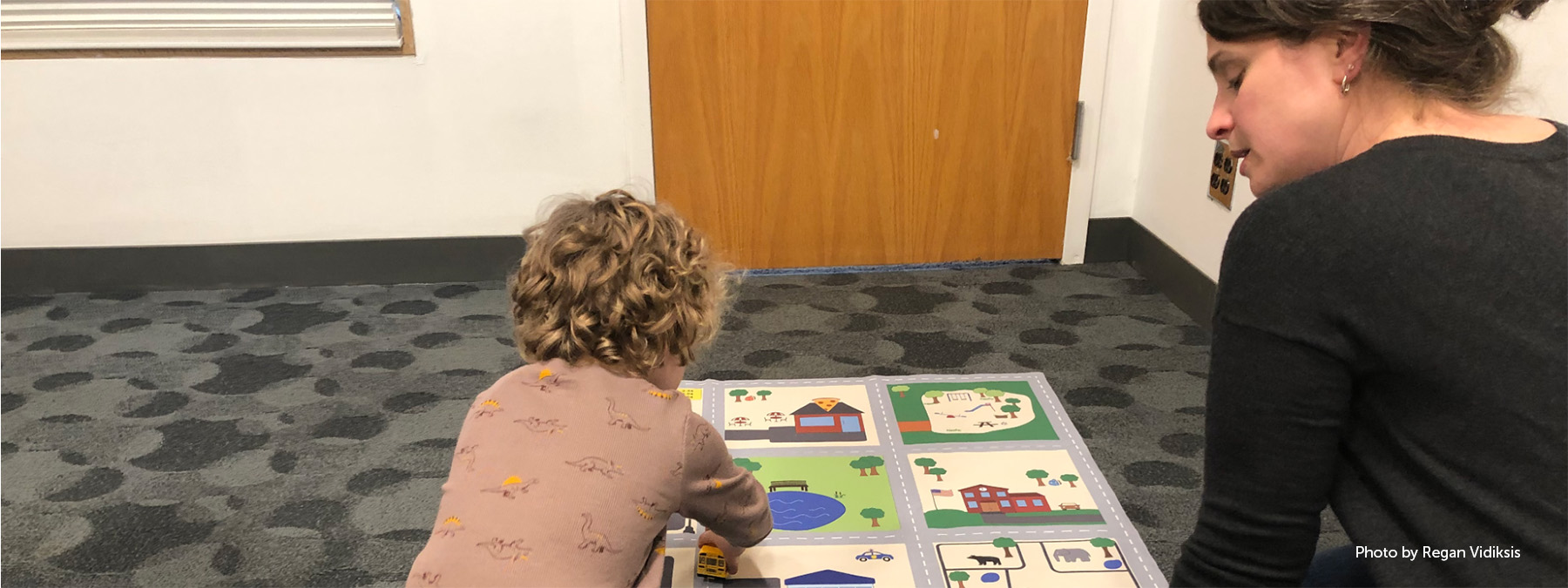
SOAT is play-based. Throughout the assessment, children engage with common toys that present playful scenarios, such as farm animals, a school bus, and a community map. The barn items invite children to demonstrate their use and understanding of spatial language asking them to point to the animal that is in the barn or to place the cow next to the barn. The community map items focus on spatial navigation and ask children to drive a toy bus to the park, pizza shop, or school and use different landmarks to navigate to those locations. For example, children are asked to drive the bus to the playground and find the soccer ball.
SOAT is developmentally appropriate. Preschool children may not always use language to share what they know, which is why SOAT includes multiple ways for children to respond to different assessment items. They are invited to point, move objects, or use gestures. This assessment format is playful and engaging and allows children to demonstrate their knowledge and understanding using multiple modalities.
SOAT is intentionally designed. This tool not only gathers important data about what young children are learning, but also fosters intentional and playful engagement that reflects how children naturally learn. With this approach, we aim to deepen our understanding of preschool children’s math learning and identify the most effective ways to support their development.
Want to learn more about SOAT?
- Reach out to Ashley Lewis Presser or the Early Learning Team at Digital Promise.
- Learn more about the development and testing of the classroom and home-based resources featured in this paper.
This research was funded by the National Science Foundation (DRL-2048883). Any opinions, findings, conclusions, or recommendations expressed in this material are those of the authors and do not necessarily reflect the views of the National Science Foundation.
References
- Topics: Classroom Practice , Core Content
- Learning Environments: Early Childhood Learning
- Audiences: Researchers
- Offerings: Research and Development
- Programs: Learning Sciences Research