

Chemistry Courseware Outcomes Research and Evaluation (ChemCORE)
Part of Learning Sciences Research
Chemistry Courseware Outcomes Research and Evaluation(ChemCORE) is a multi-year study led by Digital Promise to examine teaching practices and a new courseware designed to improve student outcomes in college General Chemistry I courses.
Audiences
Learning Environments
Overview
Success in college gateway STEM courses, such as General Chemistry, can advance students’ progress toward completing their degrees, which can then lead to high-paying, fulfilling careers. However, many students end up deterred from furthering their studies due to poor experiences and outcomes in these introductory courses. Furthermore, course success rates are not evenly distributed across all student populations, with low-income and racially minoritized students being more likely to receive a below passing grade.
Evidence-based teaching practices and high-quality courseware that support these practices have the potential to change student experiences and success rates. Digital Promise is nearing the end of a multi-year study, launched in 2023, that examines teaching practices and a new courseware designed to improve student outcomes in General Chemistry I courses. Throughout the study, Digital Promise will share early findings with the broader community. Watch this space for updates on the research.
About
Equity issues persist in college General Chemistry courses, with low-income and racially minoritized students being less likely to receive a passing grade. While, in general, about a third of students do not pass their introductory chemistry course, this figure is 45% or more for many minoritized groups.
Digital Promise is leading a research study focused on evidence-based teaching practices and student learning. With support from the Gates Foundation, we are studying teaching and learning in college-level General Chemistry courses and examining whether REAL CHEM, a new digital learning courseware developed by Arizona State University and Carnegie Mellon University, achieves its goals of enhancing course engagement and outcomes for students, particularly those who are low-income, Black, Latinx, and/or Indigenous. By harnessing learning research, equity pedagogy, and learning technology, we should be able to reliably produce successful course outcomes for these students.
The project team meets regularly with our Chemistry Advisory Board (CAB), consisting of practitioners and researchers listed below who have diverse experiences and expertise in chemistry education:
- Melanie Cooper — Michigan State University
- Tom Higgins — Harold Washington College
- Ram Hona — United Tribes Technical College
- Resa Kelly — San Jose State University
- Daniel King — Drexel University
- Lance Lund — Anoka-Ramsey Community College (Retired)
- Kristen Murphy — University of Wisconsin-Milwaukee
- Florastina Payton-Stewart — Xavier University of Louisiana
- Paulette Vincent-Ruz — New Mexico State University
ChemCORE Team




Jonathan Pittman
Project Manager

Ellen Tedeschi, Ph.D.
Senior Quantitative Researcher


Xin Wei, Ph.D.
Senior Quantitative Researcher
Reports
Choi, Y. H., Alexander, T. & Neisler, J. (2026). Beyond Active Learning: Instructor Practices Connected to Students’ Sense of Belonging in Introductory STEM Courses. College Teaching. https://doi.org/10.1080/87567555.2026.2668376
Our Reach
Over the course of three years, colleges and universities across the country joined our research to examine how interactive courseware, combined with equity-minded, student-centered pedagogy, affects learning outcomes and student success.
Our sample is composed of:
- 30 institutions of higher education (15 two-year and 15 four-year institutions)
- 55 instructors teaching 125 classes
- More than 6,100 students
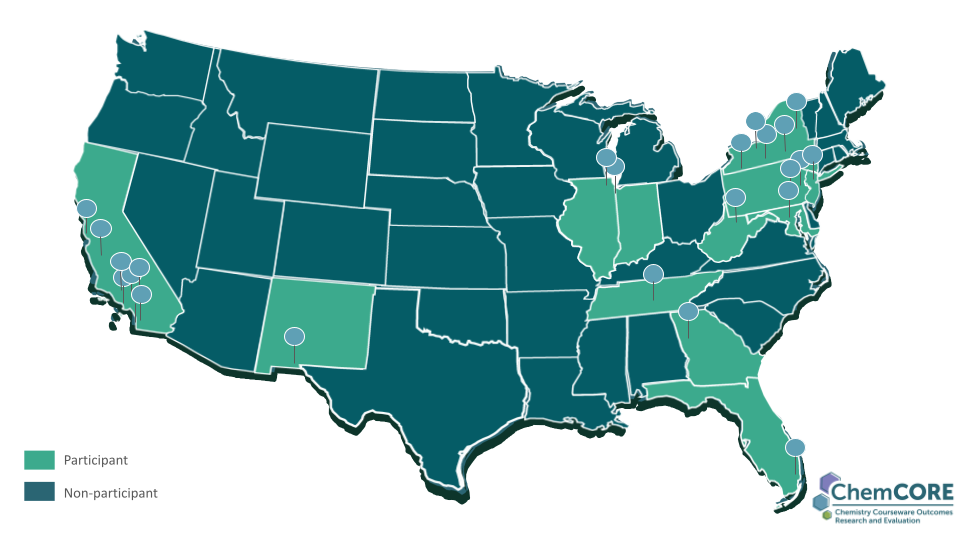
Our partners are helping advance the field’s understanding of how to enhance engagement and learning in General Chemistry, especially for low-income, Black, Latinx, and/or Indigenous students.