

Key Ideas
- School communities are exploring the opportunities and risks of artificial intelligence (AI) in education, especially as it relates to digital equity.
- We need a systems-level approach to addressing digital equity as educators envision how to incorporate AI for teaching and learning.
- A systems view of AI in education would help identify opportunities and risks, but also focus on creating strong systems to safeguard against those risks and to realize opportunities.
School communities everywhere are exploring the opportunities and risks of artificial intelligence (AI) in education. A major theme of those opportunities and risks is digital equity; how might AI progress us towards digital equity and how might it move us even further away?
As part of these explorations, we’re seeing two trends in approach:
- A “spotlight approach” that identifies and focuses on addressing one key issue at a time. For example, a school leader might be focused on algorithmic bias in the AI tools their students use as a key equity issue.
- A “gaps approach” that highlights multiple challenges at once. For example, the U.S. Department of Education’s newly released National Educational Technology Plan frames issues of digital equity and edtech around design, use, and access gaps.
While these approaches can be useful to determine important risks and biases in using AI, they can also be too narrow in focusing on problems without considering the context. We need a systems-level approach to use AI in education while progressing toward a community’s vision of digital equity.
A Systems Approach to Addressing Digital Equity with AI
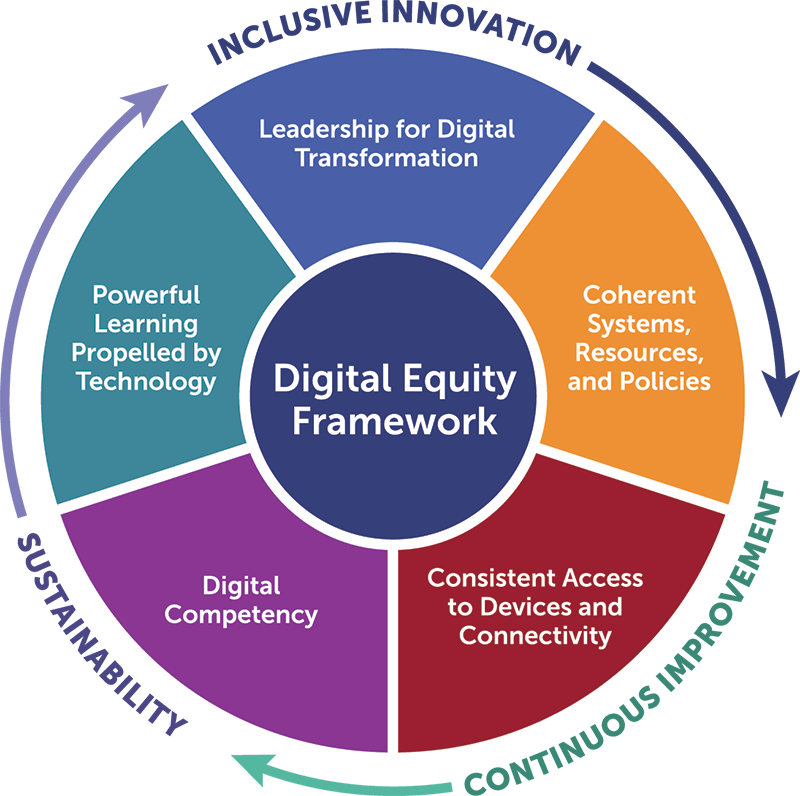
Our Digital Equity Framework offers a systems approach that prioritizes five key domains—Leadership for Digital Transformation; Coherent Systems, Resources, and Policies; Consistent Access (Devices & Connectivity); Digital Competency; and Powerful Learning Propelled by Technology. Together, the domains are designed to address the digital design, use, and access gaps. Taking a systems approach of AI in education would incorporate aspects of the spotlight and gaps approaches listed above, but also focus on creating strong systems to safeguard against risks and to realize opportunities.
Here’s an example: A spotlight approach highlights new risks of AI in schools that go beyond familiar risks of edtech, such as privacy and data security risks. Within the “Coherent Systems, Policies, and Resources” domain, an automated surveillance system based on AI may unfairly result in disciplinary referrals for students of color more often than for students from other groups. More generally, algorithmic bias can lead to harmful decisions about school course schedules, grading, career counseling, and other issues. However, a spotlight approach focuses on just one issue, which misses the bigger picture. A systems approach would include this risk while acknowledging the multiple dimensions, policies, and resources necessary to advance digital equity goals.
Similarly, the gaps approach has its strengths in that it helps to identify both problems and opportunities with AI in education. For example, within the “Powerful Learning Propelled by Technology” domain, a design gap approach might explore how AI is being applied in education because it is novel and useful, but not necessarily with an understanding of learning principles or processes. AI may also make it faster to create lesson plans, but we’ve found it difficult to use AI to write lesson plans that incorporate the insights found in the What Works Clearinghouse practice guides. More favorably, we’ve heard from many teachers that the ability of AI to work with multiple forms of input (text, speech, drawing) and to produce multiple forms of output (written text, audio, pictures) help support their students with disabilities or neurodiversity. Compared to this gaps approach, a systems approach is not only about remediating individual gaps that lead to inequality, but also envisioning how the system can comprehensively progress towards digital equity.
What a Systems Approach to Addressing Digital Equity with AI Can Look Like
At Digital Promise, we view digital equity as a dynamic concept embodied by those five key domains listed above. These domains build upon each other to create a Digital Equity Framework and underscore our steadfast belief in inclusive innovation, continuous improvement, and sustainability.
The diagram below shows how to approach digital equity at a systems level and can be applied to the use of technology—including emerging technologies like AI—in education.
Imagine the following scenario: A school district wishes to use AI to provide additional support to students with Individualized Education Plans who need personalized resources to strengthen their learning. Using the Digital Equity Framework, we might consider the following questions:
- From a “coherent policy” perspective, how will the district check that it does not compromise student privacy when sharing the student data needed to personalize resources?
- From a “consistent access” perspective, will the students be able to use these resources at home or in community locations as they study, or will they experience barriers?
- From a “digital competency” perspective, will teachers be supplied with professional development that enables them to use generative AI to differentiate lesson plans and other materials for students, including knowledge of the kinds of errors, misinformation, and mistakes that may be introduced into materials, and the potential for harmful biases to be communicated to a student with a disability?
- From a “powerful learning” perspective, are there strong learning principles (such as the Universal Design for Learning approach) at the basis of the newly recommended materials?
- From a “leadership” perspective, are leaders orchestrating the necessary coordination, guidance, and support so that these elements are well-integrated and consistently applied throughout the school system?
- Most importantly, how are leaders engaging their communities to move beyond spotlight or gap viewpoints and deeply advance toward their digital equity goal?
At our Feb. 23 webinar, “How Can Educational Leaders Strengthen Digital Equity in an Age of AI?”, we explored scenarios like the one above and discussed how we can use the systems approach to address digital equity in an age of AI, offer additional guidance to educational leaders, and stimulate discussions about next steps. Watch the recording on the Digital Promise YouTube channel.
- Topics: AI and Emerging Tech , Evidence-Based EdTech , Systems and Leadership
- Audiences: Researchers
- Programs: Learning Sciences Research