
What Does the Research Say? 3 Guidelines for Designing STEM Opportunities for Early Learners
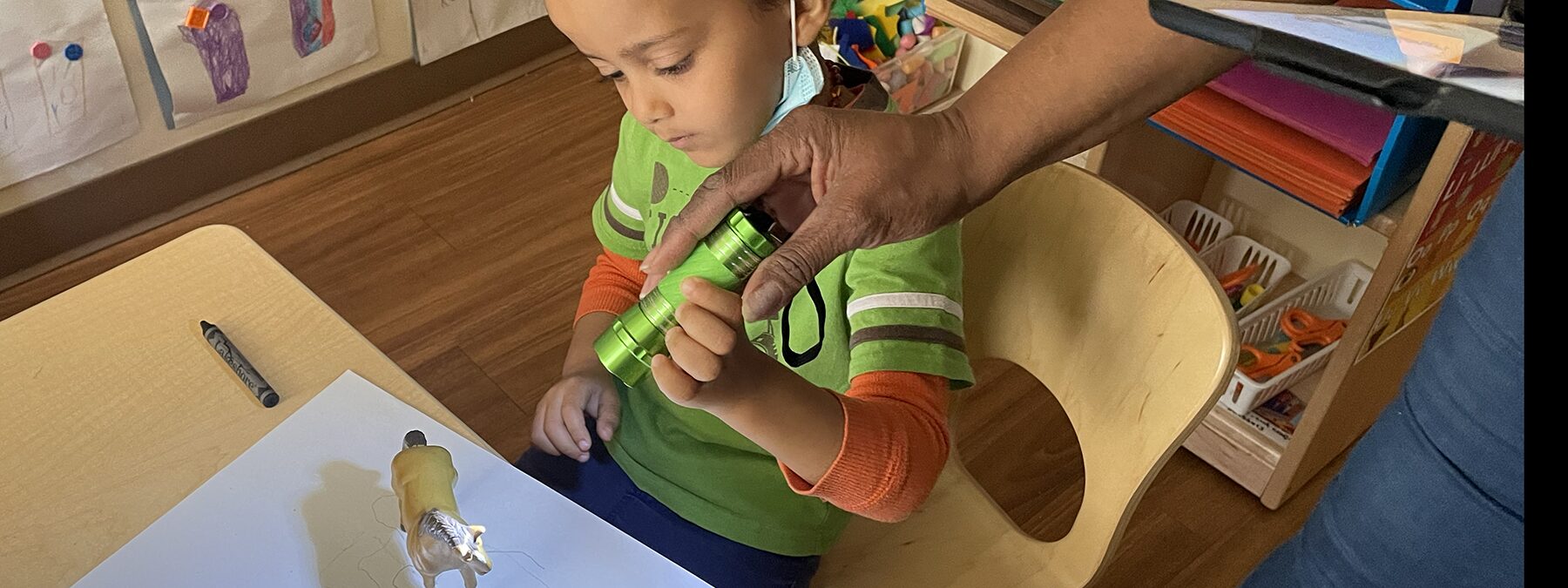
Key Ideas
- Preschool children have the capacity to learn science, technology, engineering, and math (STEM) concepts, but have few opportunities to do so.
- Co-design and professional learning for teachers are vital to develop STEM education innovations for early learners that are usable and impactful.
- Emerging technologies can play a role in early education, but we must proceed cautiously and thoughtfully investigate the opportunities—and challenges—of these tools.
A recent report by the National Academies calls attention to the importance of promoting science, technology, engineering, and math (STEM) early in childhood and the need to strengthen STEM learning opportunities in preschool and elementary school.
At Digital Promise, we believe that teaching STEM in preschool is vital for helping young learners build foundational skills that lead to long-term success. Led by Dr. Ximena Dominguez, our early learning research team has been working on several projects that incorporate play and technology into innovative STEM learning opportunities for young learners. Along the way, we’ve learned some important lessons about how researchers can help preschool learners—and their teachers—build valuable knowledge in STEM.
Co-design leads to powerful innovations
The process of co-design, where researchers collaborate closely and frequently with educators, families, and local communities, is essential when designing STEM learning experiences for young learners.
Co-design values the voices of others. It gives families and teachers, who play important roles in the daily lives of young learners, opportunities to share their perspectives and actively shape how researchers approach their investigations. By providing space for these individuals to contribute their unique expertise, co-design ensures that the resources created include learning opportunities that reflect and benefit the school communities where they will be used.
Co-design values the voices of others. It gives families and teachers, who play important roles in the daily lives of young learners, opportunities to share their perspectives and actively shape how researchers approach their investigations.
Co-design was a core value when developing Early Science with Nico and Nor®, a digital preschool science program for school and home. To create this program, our researchers worked closely with teachers, families, curricula and media developers to ensure the resulting resources—a suite of 11 science learning apps, dozens of hands-on activities, and a teacher and family guide—would not only be supported by research, but also could be easily implemented by the people who teach young learners: families and educators.
Our early learning research continues to infuse co-design into our ongoing projects. For example, we are currently working with YMCA preschool educators and families in California to co-design outdoor STEM learning spaces and professional learning resources for educators.
Professional development must be part of the toolkit
Throughout our ongoing collaborations with early learning educators, teachers have expressed the need for more support when it comes to teaching STEM to preschool children. In some cases, they want to learn more about the STEM content itself; in others, they want to better understand how they can integrate STEM into their preschool environments.
Once again, co-design plays a vital role in developing practical and effective teacher resources. For example, our National Science Foundation project Professional Learning Hub for Early Science (HubES) brings together public preschool teachers, families, researchers, and media designers to co-design a professional learning hub to help teachers feasibly and effectively promote science in their preschool classrooms.
As part of this hub, our research team hopes to create a video library that shows examples of real educators in real preschool classrooms modeling developmentally appropriate science practices. These videos will give early education teachers the support they need to implement research-based materials in their classrooms and engage their young students in meaningful and fun science learning.
“Our goal is to design resources in partnership with educators to ensure they are meaningful and can be feasibly adopted and sustained over time,” said Dr. Dominguez, principal investigator on the project.
The project team also plans to create interactive simulations of science content to help preschool teachers familiarize themselves with STEM concepts. “It’s important to provide educators with opportunities to engage with science content,” said Dr. Dominguez. “We hope these resources will help teachers feel more confident when working to deepen young learners’ understanding of science ideas.”
Emerging technologies have promise—but proceed with caution
As artificial intelligence (AI) and other emerging technologies become more popular in K-12 education, the question of how, or if, these tools should be incorporated into early learning contexts is not uncommon.
The use of emerging technologies in early learning contexts is often associated with increased screentime, which poses concerns for some families and teachers. In addition, frequently raised concerns around AI, such as data privacy and bias, are magnified when it comes to our youngest learners. Proceeding with caution is key; efforts must thoughtfully explore and investigate how educators can use emerging tools to help—not harm—young learners.
To discuss this important topic, our team recently led a session at the 2025 AI K12 Deeper Learning Summit AI Summit in Anaheim, California. In a conversation facilitated by Dr. Dominguez, The LEGO Foundation and the teams behind the Kibeam wand and Scratch discussed how edtech producers can partner with early childhood educators and families to design emerging innovations that provide meaningful, playful, socially-rich, and interactive learning opportunities critical for early learning. The session highlighted the importance of child agency and well-being as two key dimensions of edtech design in early education.
To stay updated on our research in early learning, subscribe to our Learning Sciences Connections newsletter and learn more about our current projects.
- Topics: AI and Emerging Tech , Classroom Practice , Core Content
- Learning Environments: Early Childhood Learning
- Audiences: Researchers
- Offerings: Research and Development
- Programs: Learning Sciences Research