
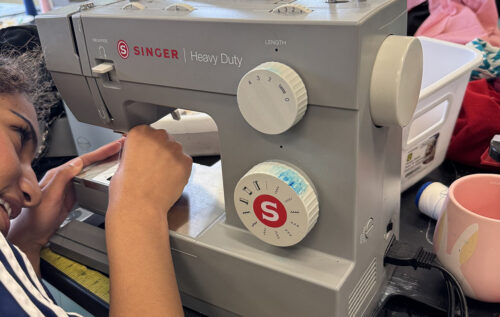
Key Ideas
- A student-led idea for a fashion class grew into a popular program centered on creative design, sewing, and sustainable use of repurposed materials.
- Teaching students to repair, reuse, and redesign can help foster a mindset of creativity, resourcefulness, and sustainability.
- When students help shape their learning, they create experiences that are more meaningful, creative, and impactful for themselves and their communities.
Student voice is a phrase we hear a lot in education, but what does it mean?
In my classroom, this has looked like designing projects that offer choice, ultimately selecting a pathway through the project that is reflective of students’ likes, dislikes, and views of the world. I enjoy this approach and find it works really well for students. I am, however, always looking for new ways to challenge both my students and myself.
A few years ago, my class did a project where they had to make a piece of clothing out of leftover fabric. Near the end of the semester four of my students approached me about starting a fashion class. (Click to listen to the story)
We set to work. It was a lot of hoops to jump through, a lot of thinking and planning, and a lot organizing. I handled the administrative tasks—sourcing a course code, speaking with our principal, researching courses at other schools—and the students started drumming up interest. It took us two years to get enough students to sign up, but once we did, we were in business.
Fashion class mattered to me because I’ve always loved thrifting and wanted to make my clothing choices more sustainable. Learning how to sew has given me the skills to alter and upcycle thrifted clothes so they fit me.
Building a Class Together
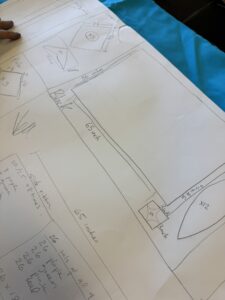
As a part of our course development we discussed the main direction of the course. We wanted to focus on two things: creativity of design (creating their own patterns from scratch) and sustainability (using repurposed and upcycled fabrics).
As someone who has been sewing since a very young age, I make most of my projects without a pre-bought pattern and felt confident I could walk the class through each of the types of pieces they might wish to make. At the same time, I did not feel that simply making specific projects and teaching all the students to make the same thing would satisfy the “creativity of design” brief we all agreed was essential.
My core group of students came up with many ideas of projects they might like to design, and we settled on the basic idea of distilling them into four projects:
- Accessories
- Shirts
- Pants/shorts
- A final project of their choosing
Creativity with a Purpose
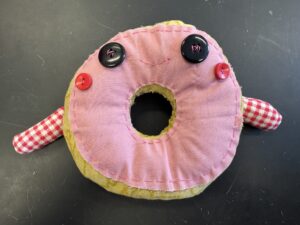
For each project, I show my class the basics of how to make the garment (e.g., a shirt with sleeves) and some variations (e.g., a button-down, dropped sleeves, a peplum, etc.) and then students design their own garment building on the basics they have learned.
This has since become the Grade 11 version of the course, with the now-solidified Grade 12 version focusing on the students proposing and then completing 4-5 independent garments.
Not only did the students conceive these class structures themselves, but the format ensures that all students who take the class will have a large amount of control over their projects, while also learning the necessary basics.
This class is important to me, a way to make my ideal clothing pieces that I often struggle to find in stores due to it not being modest enough. This class allowed me to turn my dream pieces into a reality. Through development of different skills and techniques from pattern making to the assembling of the pieces, it has become an important life skill learnt that will be used over the course of my life.
Making Sustainability Part of the Process
Next, we tackled sustainability.
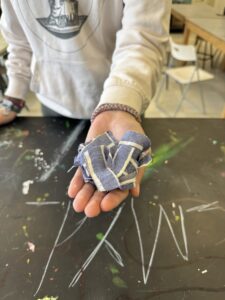
Our goal was to be able to run the course on entirely repurposed fabric, including pre-loved items, dead stock fabric, and leftovers of seamstress stashes. We sourced these in every way we could. Friends, family, colleagues, neighbors, and community members donated fabric until we had what now feels like a miniature fabric store occupying more than half my classroom cupboards.
Our school operates a free thrift shop made up of lost-and-found items, donated clothing, and leftover spirit wear. At the start of each project, students “shop” there first, replacing anything they take with clothing they no longer need. We also make trips to a nearby thrift store to source materials and only visit the fabric store as a last resort, focusing on off-cuts and deadstock fabrics.
Additionally, students bring in sheets, curtains, clothing, and fabric from home. Combined with donated buttons, zippers, snaps, and hooks, we now purchase very little beyond thread.
Turning Obstacles into Opportunities
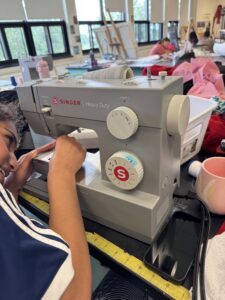
With creative-pattern-making and materials sorted, one major roadblock remained: sewing machines. We had none.
After a significant amount of scrambling during that first semester, we ran the entire class using two half-working machines from the family studies department that I cobbled together from four broken ones, along with my grandmother’s sewing machine from 1967.
Despite that, the course was a massive success. We quickly grew from one small Grade 11 class to two full Grade 11/12 classes every year. Knowing that nearly 60 students would soon be using just three aging machines, it was clear something had to change.
Enter the Ciena Solutions Challenge.
I had previously collaborated with a colleague whose students had used a grant from Ciena to create shirts for Orange Shirt Day and Pink Shirt Day for every Grade 9 student in our school. After seeing the success of our new fashion class, he suggested we apply for a Ciena Solutions Challenge Sustainability Award to purchase industrial sewing machines.
Together, the students and I submitted an application, and we were successful.
With this support, we purchased three sewing machines, which now operate alongside my own machine and have supported the program for the past three semesters. More recently, we received a second Sustainability Award, which allowed us to purchase a serger sewing machine and two additional standard sewing machines that will expand what students can create in the coming year.
More Than a Fashion Class
Today, we run two full classes for students in Grades 11 and 12 every year, each with a waiting list.
This year, three exchange students enrolled in our school specifically because they wanted to take the class. One even rearranged her second-semester schedule to fit the Grade 12 course and now plans to return to Germany and start a sewing club at her school, sewing “every present I ever give to anyone, forever.”
The impact has extended far beyond the classroom.
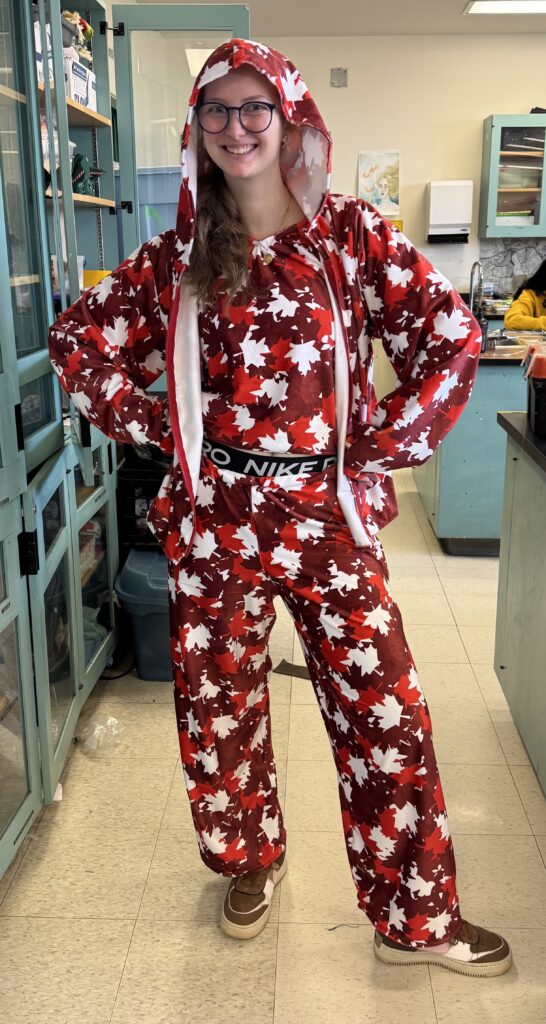
One 16-year-old student sewed her own regalia for a fancy shawl dance, which was an extraordinary accomplishment. Three students have started successful businesses using the skills they developed in class. One of our founding students not only earned admission to fashion school but also secured an internship in Milan and graduated as the top student in her class.
More than anything else, the return of several graduates to speak with the class and volunteer their time and mentorship (of their own offering, unprompted) has really shown me what a difference the class has made in their lives.
Through this project I have seen so many students not only grow their knowledge of and skills in sewing and pattern making, but I have seen dozens of students find a new passion, bridge generational gaps, and rediscover cultural roots and practices. It’s immensely rewarding to see the students not only taking the projects seriously, but making extensive personal connections and finding great meaning in their work.
Through our commitment to using upcycled, donated, and thrifted fabrics, students have also set themselves up for a lifetime of accessible artistic expression through fashion, and a means to pursue that passion in a way that is both affordable and sustainable.
Listening to Students Changes Everything
Without the support from Ciena, we would not have been able to grow this program. But without the ideas, initiative, and persistence of the students themselves, there would never have been a program to support.
For me, that’s what student voice really means. It’s not simply asking students for their opinions; it’s listening to what excites them, trusting them as partners in designing meaningful learning experiences, and creating opportunities for those ideas to grow into something that has lasting impact.
Join the Ciena Solutions Challenge
- Register for the Ciena Solutions Challenge: Educators can register now for the Ciena Solutions Challenge. Through March 8, 2027, educators can submit student projects and apply for a $3,000 Sustainability Award.
- Explore the Ciena Solutions Challenge Project Gallery and previous awardees from 2024, 2025, and 2026 for inspiration.
- Have questions? Email us at cienachallenge@digitalpromise.org.
- Topics: Classroom Practice , Core Content , STEM/STEAM
- Learning Environments: K-12
- Audiences: Educators
- Programs: Ciena Solutions Challenge