
Toolkit
Key Ideas
- Edtech founders want shared infrastructure for the work every K-12 AI company has to repeat, including child speech data, evaluation benchmarks, curriculum alignment, rostering, and application programming interfaces (APIs) for state standards.
- Frontier labs are unlikely to prioritize the narrow, context-specific needs of K-12 education, and their products are often designed to keep users on the platform in ways that can conflict with student independence.
- Even as foundational models improve, their core capabilities are becoming more interchangeable. Founders said the real difference is in how products use models, keep humans involved, fit school workflows, and build safety and trust.
Through our work in the K-12 AI Infrastructure Program, we conducted an analysis of artificial intelligence (AI) infrastructure in K-12 education. During this research, we spoke to 13 edtech founders and leaders building AI tools for K-12 about how their system architectures are evolving and what public goods they need to improve their applications. They told us where shared infrastructure would help, where currently available public goods fall short, and how these gaps limit their development or create barriers. These interviews are part of a recently published broader public report that also includes educator and other stakeholder interviews.
What Frontier Labs Won’t Build for Education
Founders agreed on two related points about frontier labs (or AI research organizations): one concerning market gaps and the other incentives. First, labs are unlikely to undertake the narrow, domain-specific work that K-12 education requires, leaving opportunities for smaller companies. As one founder explained, “Frontier labs are all racing toward AGI [artificial general intelligence]…What they’re not going to do is any of the in-the-weeds work like create a math visualization benchmark or do teacher coaching because it’s too difficult, too context-dependent.” Although frontier labs have released teacher-facing tools, these support lesson planning and preparation rather than instructional coaching or professional development for classroom practice.
Even the broad capabilities these labs develop create an incentive problem—their models are designed to maximize engagement, which can undermine the independence many education tools are trying to foster. Another founder noted, “General-purpose AI is built for keeping people on their product all the time. It’s not built with students in mind.”
The Shared Infrastructure Founders Asked For
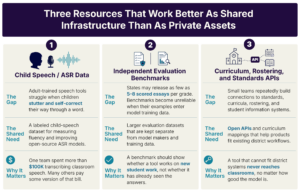
When we asked founders what shared infrastructure should include, the same assets were mentioned repeatedly. Automatic Speech Recognition (ASR) models trained on how children actually talk, child speech datasets to develop such models, benchmarks held apart from training data and large enough to test against new student work, and APIs that let products plug into existing school systems (see below).
“Building a facilitation model as a public good might erode some of our competitive advantage, but it would be of tremendous use for the field.” — Edtech founder
When the Model Stops Being the Differentiator
Founders were clear that better foundation models make a difference, but they also described technical differentiation as increasingly short-lived. A capability that takes a small team months to build can be absorbed into the next model release. For that reason, several founders said the durable work is no longer just AI model performance, but the systems built around the model. This includes how it is prompted, evaluated, constrained, connected to existing school workflows to perform specific educational jobs well, and handed back to a human when judgment is required.
“The implementation of AI is almost as important or more important than the AI itself.” – Edtech founder
For example, for a teacher-evaluation product, that meant designing the AI-based application around a school’s established classroom observation frameworks, prompting principals to review and edit the output, and making the tool support growth conversations rather than replace them. As models improve, that surrounding system can improve with them.
This is where human-in-the-loop design becomes important. Founders described it as part of the product architecture. In practice, that meant teachers reviewing AI-generated evaluations and being notified when a situation calls for it, and students being redirected toward counselors, family members, or peers when the AI should not be the endpoint. The product encompasses the set of decisions about when the model should answer, when it should defer, and when a human should step in.
Edtech leaders are trying to be responsive to demands from districts to tailor applications for local context and curricula without infringing privacy or data governance safeguards. They need open APIs and curriculum mappings that facilitate integration across systems.
What This Means for the Field
The conversations we are having with founders are shaping where we invest. Child speech data, evaluation benchmarks, curriculum APIs, and shared safety protocols all point to the same underlying need: K-12 AI infrastructure should reduce the work every team is currently doing on its own, while making education tools more accurate, more interoperable, and more trustworthy inside real classrooms and school systems. The full public report includes additional findings from educators and other stakeholders, including where their needs align with and diverge from the founder interviews.
Want to learn more?
- Read our latest report, K-12 AI Infrastructure: Findings from Educator and Developer Outreach, for more insights from educators and developers.
- Sign up for our newsletter to stay up-to-date on upcoming grant opportunities.
- Explore the K-12 AI Infrastructure Program’s platform for open K-12 AI challenges, benchmarks, and datasets.
- Topics: AI and Emerging Tech , Systems and Leadership
- Learning Environments: K-12
- Audiences: EdTech Developers , Researchers
- Offerings: EdTech Strategy and Standards , Global Networks and Convenings , Research and Development
- Programs: Learning Sciences Research