
Skip to navigation Skip to content Skip to footer

Digital Promise

Menu

Blog

AI and Emerging Tech

AI Literacy: A Framework to Understand, Evaluate, and Use Emerging Technology


Key Ideas

  • AI literacy includes the knowledge and skills that enable humans to critically understand, evaluate, and use AI systems and tools to safely and ethically participate in an increasingly digital world.
  • Digital Promise’s framework recommends AI literacy practices for learners and strategies for leaders to integrate into PK-12 education.
  • We call on school leaders and policymakers to build on existing initiatives to champion AI literacy for all learners, educators, and community members to ensure safe and responsible use of emerging technologies.

Introduction

In our latest paper, AI Literacy: A Framework to Understand, Evaluate, and Use Emerging Technology, Digital Promise shares a framework to leverage artificial intelligence (AI) tools for powerful learning and strategies for educational leaders to implement a clear approach to AI literacy.

As AI becomes increasingly prevalent in our daily lives and educational settings, it is imperative to equip learners, educators, and leaders with the necessary skills and knowledge to navigate this technology responsibly. We envision safe, equitable, and meaningful AI and emerging technologies that improve education by enhancing how we teach and learn. Thus, AI literacy has emerged as a skill set for everyone to safely and effectively use these emerging technologies.

AI literacy includes the knowledge and skills that enable people to critically understand, evaluate, and use AI systems and tools to safely and effectively participate in an increasingly digital world.

AI Literacy Framework
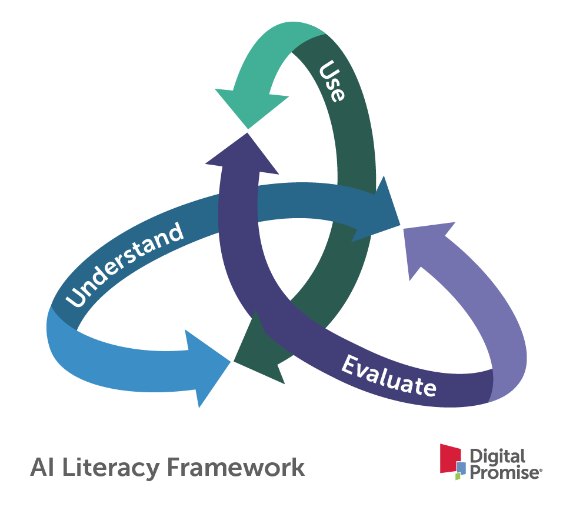
A 3D triangular diagram with three bidirectional arrows. The bottom left arrow is blue and labeled 'understand', the bottom right arrow is purple and labeled 'evaluate', and the top arrow is green and oriented vertically, labeled 'use'. The text labels are embedded in the main shaft of the arrows in white font.
Figure 1. AI Literacy Framework includes three components: Understand, Evaluate, and Use

Our framework defines three interconnected Modes of Engagement to support robust engagement in AI literacy, including:

  • Understand: Acquiring basic knowledge of what AI can do and how it works in order to make informed decisions about evaluating and using AI systems and tools.
  • Evaluate: Centering human judgment and justice to critically consider the benefits and/or costs of AI to individuals, society, and the environment.
  • Use: Interacting, creating, and problem-solving with AI as a progression of use for distinct contexts and purposes.
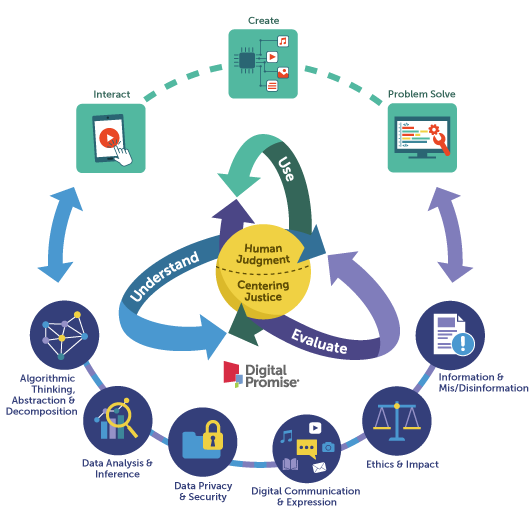
In the center of the expanded framework image is a 3D triangular diagram with three bidirectional arrows. The bottom left arrow is blue and labeled 'understand', the bottom right arrow is purple and labeled 'evaluate', and the top arrow is green and oriented vertically, labeled 'use'. At the center of the three bidirectional arrows is a yellow sphere with the text "Human Judgment" on the top half and "Centering Justice" on the bottom half. Surrounding the sphere and arrows are icons arranged in a circle formation. The top three icons correlate to types of 'use' and have a green background, connected with a green dotted line. The icons represent 'interact,' 'create,' and 'problem solve.' The bottom six icons represent AI literacy practices for 'understand' and 'evaluate' with an indigo background, connected with an alternating blue and purple dashed line. The icons represent 'data privacy & security,' 'ethic & impact,' 'digital communication & expression,' 'information & mis/disinformation,' 'data analysis & inference,' and 'algorithmic thinking, abstraction, & decomposition.' The top three green icons and the bottom six indigo icons are connected with a bidirectional blue arrow on the left and a bidirectional purple arrow on the right.
Figure 2. Expanded AI Literacy Framework, including Core Values, Modes of Engagement, Types of Use, and AI Literacy Practices

Our expanded AI Literacy Framework depicts the relationship between AI Literacy Practices, Core Values, Modes of Engagement, and Types of Use and elaborates essential components of AI literacy to support educational leaders in adapting it to their contexts.

Table 1. Components of expanded AI Literacy Framework

Strategies to Promote AI Literacy in PK-12 Education

Public schools have a critical role to integrate AI literacy throughout PK–12 education so that our current and future communities are aware and able to critically evaluate AI systems. Our paper outlines five strategies to promote AI literacy in PK–12 education, with examples and guidance for implementing each strategy.

  • Strategy 1: Provide Guidance for Adoption and Evaluation
    Systems Leaders and Policymakers
  • Strategy 2: Integrate AI Literacy Across Grades and Subject-Area Learning
    System and School Administrators
  • Strategy 3: Facilitate Ongoing, Just-In-Time Professional Learning
    Instructional Leaders
  • Strategy 4: Design Powerful Learning Experiences
    Teachers and Instructional Leaders
  • Strategy 5: Promote Awareness and Agency
    Leaders, Teachers, Learners, Caregivers, and Community Members

Informed users are essential for the safe and effective use of AI. We call on school leaders and policymakers to champion AI literacy for all learners, educators, and community members. Together, we can ensure the responsible adoption of emerging technologies.

Want to know more about AI literacy? Find more resources here:

Authors

Keun-woo Lee

Kelly Mills

Senior Director, Research

Pati Ruiz

Director of Learning Technology Research

Merijke Coenraad

Project Director, Research Practice Partnerships

Judi Fusco

Director Emerging Technologies and Learning Sciences

Jeremy Roschelle

Co-Executive Director, Learning Sciences Research

Read bio

Jeremy Roschelle, Ph.D., serves as co-executive director of Digital Promise’s Center for Learning Sciences Research (CLSR) where he leads research on the future of learning with technology. He co-leads the NSF Engage AI Institute and leads the U-GAIN Reading R&D Center, both of which investigate advanced uses of AI in education. Dr. Roschelle is a Fellow of the International Society of the Learning Sciences, and is internationally known for his work on artificial intelligence, computer-supported collaborative learning, learning mathematics with technology, and on scaling up research-based technologies. Over his 30+ year career, he has authored about 200 publications. His publications have about 28,000 citations and he holds 10 patents.

At Digital Promise, Dr. Roschelle oversees a dedicated group of researchers and learning scientists working to improve teaching and learning across preschool, PreK-12, and postsecondary programs. His focus is particularly on improving the infrastructure for generating research evidence and creating an infrastructure for learning-sciences-based applications of AI. Programs including SEERNet, AIMS EduData, and SafeInsights are creating state-of-the-art approaches to generating evidence on digital learning platforms. The K-12 AI Infrastructure Program is funding public goods, cultivating datasets, benchmarks and models that are grounded in the learning sciences.

Prior to joining Digital Promise, Dr. Roschelle led some of the most important research studies on the efficacy of technologies for learning mathematics. He is also well-known for his contributions to collaborative learning and his leadership of several national research hubs related to educational technology. Over the course of his career, he has secured and managed tens of millions of dollars in highly competitive external funding from federal agencies and global foundations. His research has contributed to policy, products, and into practical applications in schools. He also communicates about learning sciences research and AI directly to the public through his podcast, Future Fluent, and through his large following on LinkedIn.

Dr. Roschelle earned an bachelor’s degree in Computer Science  from the Massachusetts Institute of Technology and a Ph.D. in learning sciences from the University of California, Berkeley. He enjoys jazz, backpacking and photography.