
Current
Statewide Pathways Blueprint
Part of Center for Learner Pathway Innovations
Audiences
Learning Environments

Explore More From This Program
Overview
About the Statewide Pathways Blueprint
Our blueprint for scaling pathways statewide was shaped by learnings from Digital Promise’s deep work supporting school districts nationwide in co-designing credentialed, career-connected programs with higher education, industry, and community partners.
This adaptable blueprint is designed to help states and regions build and expand career-credentialed pathways, and integrate partners at the state, regional, district, industry, and postsecondary levels to sustain and scale statewide workforce pathways.
The Framework
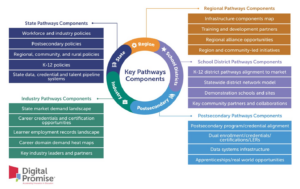
Our model has five key components that work together to align efforts for scaling effective programs and ensuring all learners have access to viable career opportunities.
ACTIVATE: State and Regional Policy Levers
This component focuses on advancing policy as a primary driver of change. It involves analyzing and aligning state policies across workforce, education, and data systems to support pathways initiatives. The most critical element is identifying a backbone organization that has the influence and relationships to provide long-term continuity and embed these pathways into sustainable infrastructure.
ASSESS: State Employment Market and Skills Opportunity
This component is about ensuring the pathways are aligned with economic reality. It requires a comprehensive analysis of state labor market demand, career credentials, and skill gaps. Collaborations with anchor industry partners will help align educational investments with workforce needs, creating an evidence base that justifies continued funding and measures long-term economic impact.
CREATE: K-12 Pathways Scale Up Model
This component focuses on building a sustainable and scalable model for K-12 districts to offer career-connected courses and credentials. It includes developing teacher certification models, providing access to work-based learning, and building a statewide network of districts to facilitate peer-to-peer learning and resource sharing.
ALIGN: Postsecondary and Credentials Landscape
This component ensures a seamless transition from high school to postsecondary opportunities and careers. It focuses on aligning postsecondary institutions with K-12 pathways by mapping out dual enrollment, stackable credentials, and accelerated certification programs. This ensures students can progress without barriers, transforming educational programs into effective career launchpads.
CONNECT: The Regional Infrastructure
This component leverages the power of regional collaboration. It involves designing and implementing pathways systems within a defined geographic area with a network of schools, postsecondary institutions, and industry partners. A regional model serves as an ideal pilot site to test approaches, generate proof points for state-level confidence, and adapt statewide strategies to local needs and contexts.