
Playbook
Key Ideas
- To achieve digital equity with AI, taking a systems change approach is necessary.
- A systems change approach should involve all participants in a school community, emphasize coherent, research-based approaches to teaching and learning, and embrace open-source software.
- Watch the first session of our Age of AI webinar series to hear more insights from a panel of experts on education and AI.
On Feb. 25, Dr. D’Andre Weaver and Dr. Jeremy Roschelle, both leaders at Digital Promise, launched the first session of our webinar series on Educational Leadership in the Age of AI. To set the stage for the discussion, Dr. Weaver presented Digital Promise’s Digital Equity Framework, or the idea that five interlocking components in an education system must work together to achieve digital equity. Dr. Roschelle then shared information about algorithmic bias and civil rights, and also connected the three equity gaps in the National EdTech Plan (digital use, digital design, and digital access) to AI.
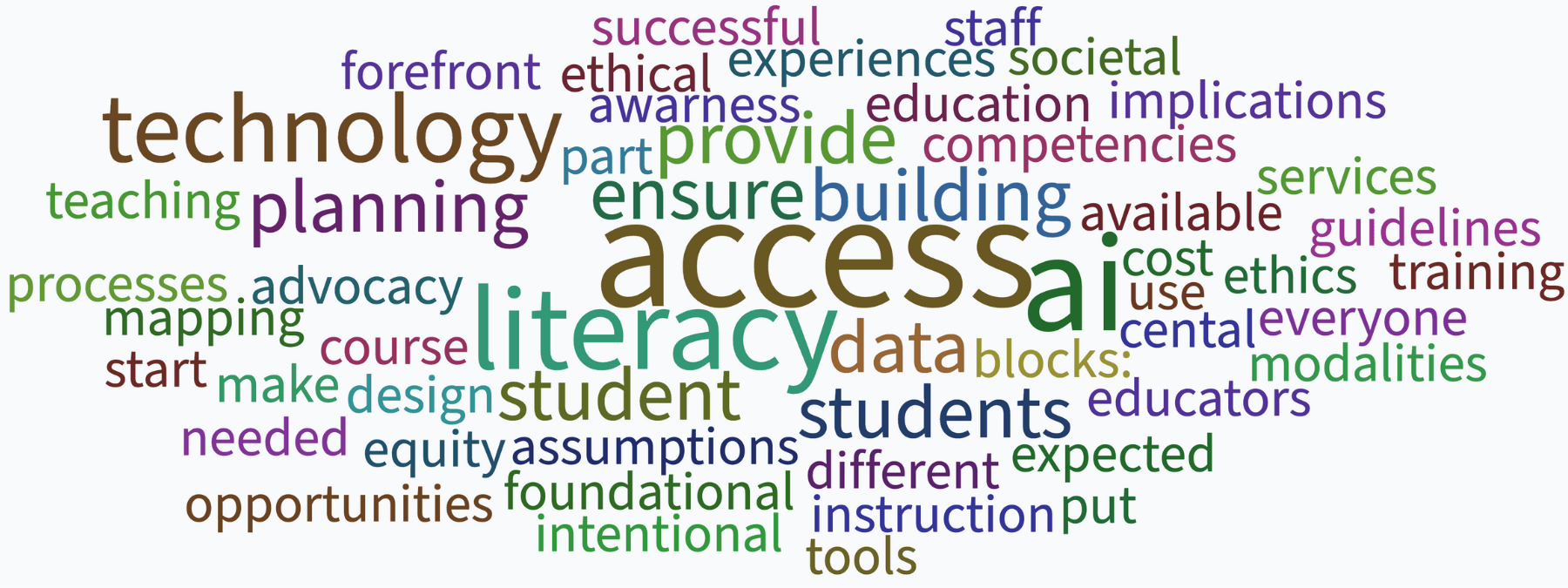
The breadth and focus on the audience response to the topic of digital equity and AI, as shown in the word cloud below, reflects the systems view that both Weaver and Roschelle support.
The facilitators then invited three panelists to share their perspectives. Panelists included:
- Dr. David Miyashiro, Superintendent of the Cajon Valley Union School District
- Rebecca Kockler, Executive Director at Reading Reimagined
- Yusuf Ahmad, Co-founder and CEO at Playlab AI
We share some highlights from their remarks below.
Dr. David Miyashiro: Implement a Systems-Level Approach
When Dr. Miyashiro first became superintendent at Cajon Valley Union School District, he saw vast inequity in terms of digital access. He described how the district implemented a systems-level approach to integrate emerging technologies and advance deeper and more personalized education for students. “By allowing teachers to be part of the development and design process, every student [at Cajon Valley] now has ubiquitous access to technology,” he said. Thanks to a systems-level approach, the district has been able to modernize their curriculum and approach.
Rebecca Kockler: Develop Instructionally-Sound Technology
Kockler believes technology like AI has incredible potential, but the technology must be coherent and instructionally-sound. She focused her attention on how powerful new technologies can enable students to learn to read. Today, many technologies for reading are more likely to be a patchwork of tools rather than a coherent approach to reading. This fragmentation and inconsistency across tools creates more work for teachers.
For AI to be a truly impactful tool in education, it must embed an understanding of how students learn to read into the tool. “AI has the potential, in reading in particular, to bring skills together in very powerful, meaningful ways that bring more context and value to learning,” Kockler said. She advocated for tech organizations to partner with robust academic teams when developing a tool to build products that will meaningfully increase students’ success in reading.
Yusuf Ahmad: Embrace Democratization While Recognizing Limitations
Yusuf Ahmad works with educators, schools, and nonprofits worldwide to build their own AI tools or adapt existing tools for educational use. Ahmad is excited that the development of AI tools is becoming more democratic, with more people being involved in defining what the tools are and how they work. “When the programming language is English, anyone can code,” he observed. “What does that make possible?”
However, a good AI tool is more than code, Ahmad cautioned. We must also provide training so creators can gain the skills to build tools that will work in educational contexts. He argued that for AI tech development to become more democratic, we should focus on making open source tools more robust. Open source also allows for AI tools in education to be built on top of models that are transparent and auditable. Yet, he also recognized that tech does not solve many issues that learners—especially those who have been historically and systematically excluded—may face, such as hunger and lack of housing. Ahmad asked the audience to “be real about what tech does and does not solve.”
Learn More
This webinar was the first in a series of webinars on educational leadership in the age of AI. Hosted by Digital Promise with support from Siegel Family Endowment and the Robin Hood Learning + Technology Fund, this series informs and supports educational leaders as they plan and adapt their priorities relating to generative AI.
Want to know more about effective, ethical, and equitable uses of AI in education? Below are additional resources to explore:
- Join us for the next session in our Educational Leadership in an Age of AI webinar series
- Learn more about how AI for education can address digital equity
- Read our Review of Guidance from Seven States on AI in Education
- Connect with our panelists on LinkedIn
- View the slides from this webinar
- Read our vision for AI in education
- Topics: AI and Emerging Tech , Evidence-Based EdTech , Systems and Leadership
- Audiences: Researchers
- Programs: Learning Sciences Research