
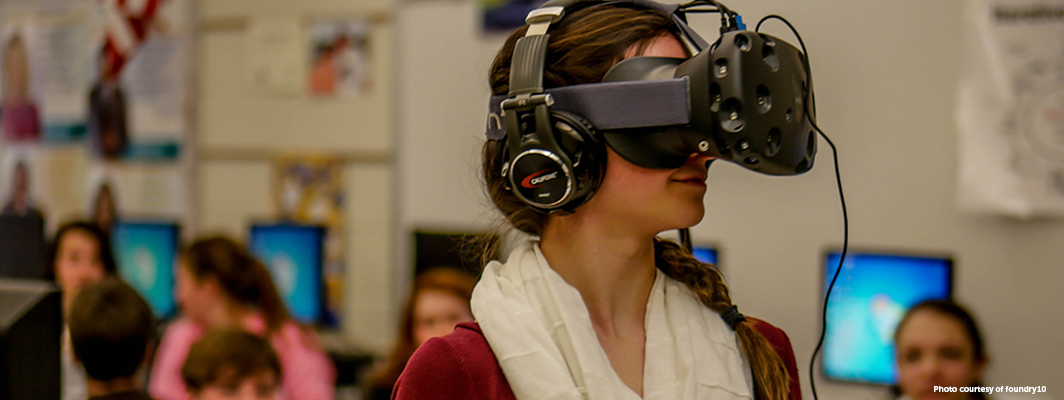
Access to technology for all students is a major goal for many schools, companies, and organizations—yet access is only part of the equation. Once an educational technology (edtech) tool is in a school, the hard work is just beginning due to a number of potential hurdles and challenges that leadership and educators need to overcome.
Research suggests that when technology is effectively used in schools, access may help to bridge educational and social gaps (Warschauer & Matuchniak, 2010; Eccles, 2009; National Science Foundation, 2017). Though often driven by good intentions, some of foundry10’s recent research suggests that there are holes around technology implementation, so we must remain focused on the objectives and actual outcomes of technology we are bringing into the learning space.
Foundry10’s 2018 study focused on technology usage in U.S. middle and high schools for 1,700 students across 22 schools. In each classroom, students were using some sort of technology, even if the course was not specifically a “tech” class. We found some areas where improvements are still needed.
Leverage Innovative Thinking in Schools
Simply because a school has technology does not mean that students are engaging with it in compelling ways. We were particularly interested in how all students, regardless of socioeconomic status (SES), were engaging with technology in schools. If students have access, is technology being used for transformative instruction and having a real impact on how students think, communicate, and connect with the world?
The majority of students said that they very often or often used technology for research, writing papers, and taking tests. While unsurprising, we were disappointed to see that 38 percent of students said they never or rarely used technology for data analysis, and 52 percent said they never or rarely used technology for programming. Almost a third of our sample never or rarely used technology for creative purposes. When we think about preparing students for the innovative future, we must ensure that a larger percentage of their time using technology is spent on activities that support innovative thinking, problem solving, and collaboration.
Other research (Holhfeld et al, 2017; Warschauer & Matuchniak, 2010) supports the idea that SES is a factor in how technology is utilized in classrooms. Students on the lower end of the socioeconomic spectrum are even less likely to have used technology in interesting ways. Our data support this and show that when we looked at the highest level of education achieved by parents, there was a strong downward trend in terms of students’ own perceptions of how they used technology. Lower SES students were much less likely to say they used technology to expand their thinking as compared to their higher SES peers.
Focus on Tech Support and Infrastructure
In our study, numerous inequities across the schools also became apparent. Although the majority of students in our survey (62 percent) felt that school was a good place to learn about technology, fewer (23%) felt that school gave them access to technology tools they may not be able to access elsewhere.
Even if a school offered an advanced technology, such as virtual reality equipment, students in the lower income schools were much more likely to encounter issues with connectivity, Wi-Fi, lack of IT support, electrical problems, and a host of other challenges that the higher socioeconomic schools did not encounter, thus making the actual implementation of the technology significantly more challenging. These issues with equity are commonplace even within districts, and they highlight a need for not just introducing technology into the classroom, but ensuring there are supports to use it powerfully.
Develop Pathways to Increase Female Students’ Engagement in “Tech” Courses
Finally, another troubling trend emerged in the gender split division. Seventy-seven percent of students said they were most likely to encounter advanced technology in “tech” courses as compared to social studies (21 percent) or language arts (13.4 percent). If we consider that in our study, tech courses were still comprised of 57 percent male and 38 percent female students versus humanities courses being 41 percent male and 52 percent female, a disparity becomes apparent in exposure to technology along gender lines.
If we can find ways to better integrate technologies (like virtual reality) into humanities courses, we may increase our likelihood of intersecting with a wider population of students. If we offer advanced technology access only to those students already enrolled in advanced computer science courses, we are missing great opportunities to connect a wider array of students with the idea that advanced technology is something for them, too.
Evaluating Edtech Quality and Use Matters
Our study serves as a continued reminder for educators, administrators, and researchers that we need to constantly evaluate how technology is used in the classroom and not just measure whether it is placed in schools. We need to think more thoroughly about how best to include all students in engaging with technology to expand their thinking and skills in truly innovative ways.
Learn More
- If you would like to see foundry10’s full findings, check out their ed tech access report and their website.
- Explore the Edtech Marketplace Today blog series to hear voices from the field share important perspectives on challenges and strategies to improve the edtech market.
- Visit the Edtech Pilot Framework to learn more about the edtech marketplace.
- Explore stories of powerful teaching and learning with technology on the Digital Promise blog.
- Subscribe to Digital Promise’s Action Report for updates on our work in this area.
- Topics: AI and Emerging Tech , Classroom Practice , Core Content , Evidence-Based EdTech , Pathways and Economic Mobility , Systems and Leadership , The Whole Learner
- Learning Environments: Adult and Workforce Learning , Early Childhood Learning , K-12 , Postsecondary Education
- Audiences: EdTech Developers , Educators , Learners , Researchers , School and System Leaders
- Offerings: Credentialing , EdTech Strategy and Standards , Practice and Professional Learning , Research and Development
- Programs: Adult Learning , Learner Variability Project , Learning Sciences Research , Micro-credentials , Powerful Learning , Product Certifications , Reinvent the Classroom