
Computational Thinking
Digital Promise is helping educators integrate computational thinking to amplify and enrich lessons across the curriculum.
Audiences
Learning Environments

Explore More From This Program
Overview
Integrating computing thinking into every classroom cannot be left to individual educators. If we are to equip every student in the next generation with the skill set to participate in our technological society, all educators, across disciplines and grade bands, need to provide opportunities for students to engage in computational skills and practices. Educational leaders at the district and school levels must prioritize the initiative and build capacity for teachers to do so.
Computational thinking is an interrelated set of skills and practices for solving complex problems, a way to learn topics in many disciplines, and a necessity for fully participating in a computational world.
What Is Computational Thinking?
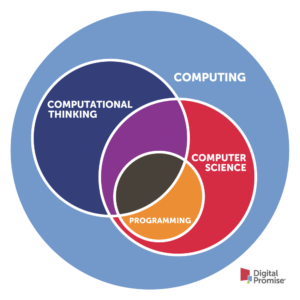
Many different terms are used when talking about computing, computer science, computational thinking, and programming. Computing encompasses the skills and practices in both computer science and computational thinking.
While computer science is an individual academic discipline and programming is the practice of developing a set of instructions that a computer can understand and execute, computational thinking is a problem-solving approach that integrates across activities.
Computational thinking leverages concepts and skills from computer science and applies them to other contexts, such as core academic disciplines (e.g., arts, English language arts, math, science, social studies) and everyday problem-solving.
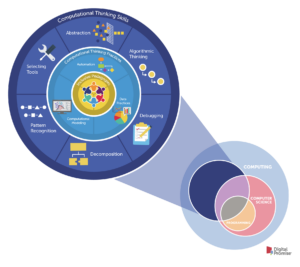
Before teachers can bring computational thinking into K-12 classrooms, they need a clear picture of what successful computational thinking actually looks like for students. Our recommended framework has three concentric circles:
- Computational thinking skills, in the outermost circle, are the cognitive processes necessary to engage with computational tools to solve problems. These skills are foundational to engaging in computational problem-solving and should be integrated into early learning opportunities in K-3.
- Computational thinking practices, in the middle circle, combine multiple computational skills to solve an applied problem. Students in the older grades (4-12) may use these practices to develop artifacts such as a computer program, data visualization, or computational model.
- Inclusive pedagogies, in the innermost circle, are strategies for engaging all learners in computing, connecting applications to students’ interests and experiences, and providing opportunities to acknowledge and combat biases and stereotypes within the computing field.
What does inclusive computational thinking look like in a classroom?
In the image below, we provide examples of inclusive computing pedagogies. The pedagogies are divided into three categories to emphasize different approaches to inclusivity.
- Designing Accessible Instruction refers to strategies teachers should use to engage all learners in computing.
- Connecting to Students’ Interests, Homes, and Communities refers to drawing on the experiences of students to design learning experiences that are connected with their homes, communities, interests, and experiences to highlight the relevance of computing in their lives.
- Acknowledging and Combating Inequity refers to a teacher supporting students to recognize and take a stand against the oppression of marginalized groups in society broadly and specifically in computing.
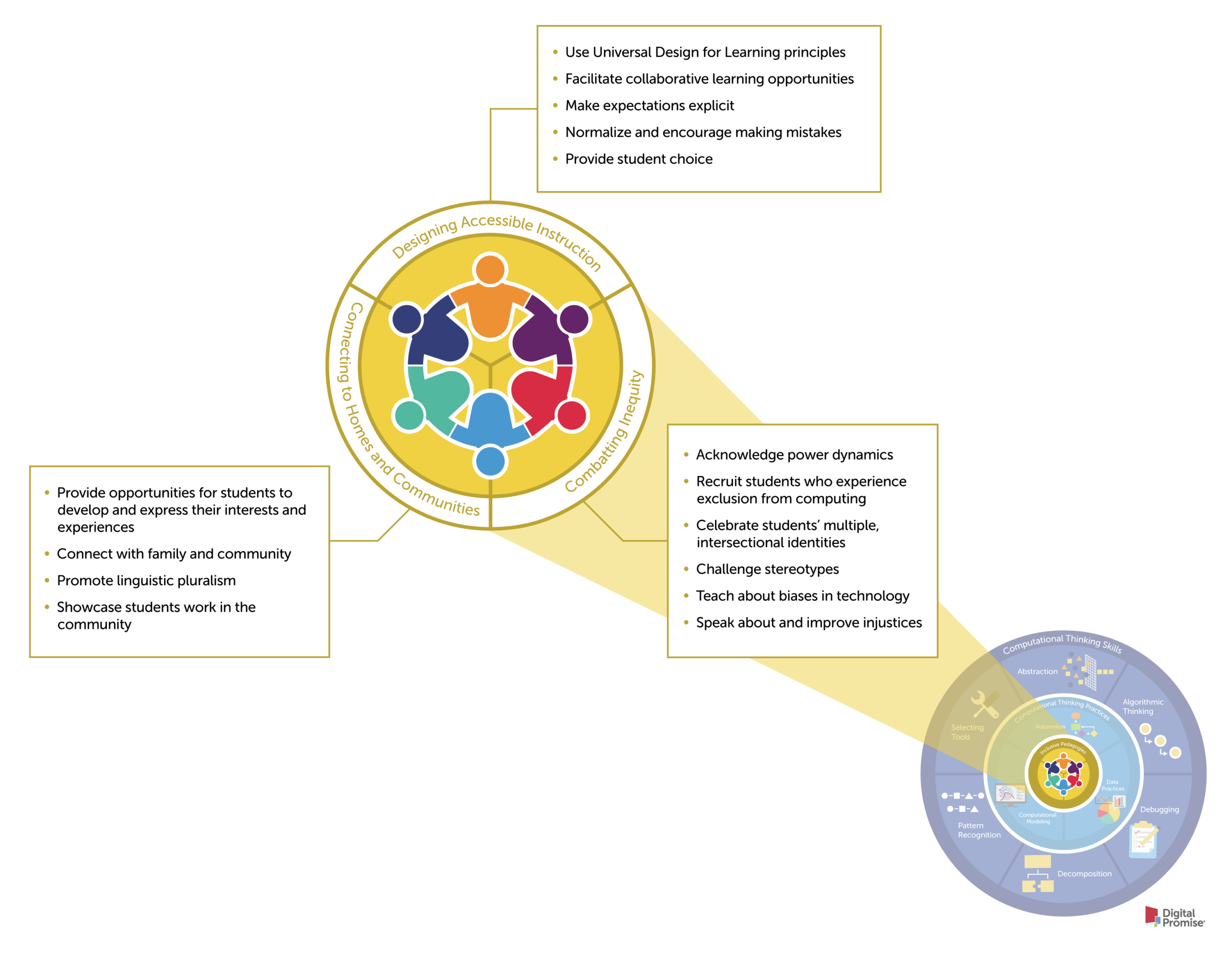
These approaches make computational thinking relevant and inclusive for all students. By bringing all three into lesson planning, teachers can connect classroom learning to real-life issues and spark critical thinking.