
Archived
Center for Integrative Research in Computing and Learning Sciences (CIRCLS)
Part of Learning Sciences Research
Audiences
Learning Environments
Overview
The Center for Integrative Research in Computing and Learning Sciences (CIRCLS) was a community-based hub of researchers exploring and investigating innovative technologies that will be more broadly available to learners in 5-10 years.
Funded by the National Science Foundation (NSF), CIRCLS built community among researchers, practitioners, developers, and other education stakeholders around the connected issues of emerging technologies, learning sciences, and diversity, equity, and inclusion. By working together, we addressed common needs in education research and development, while making a broader difference for all students.
CIRCLS was well-known for its highly interactive events, such as convenings. Participation in CIRCLS led to many relationships advancing exploratory research. CIRCLS also played a role in synthesizing the work of the community members and reflecting on the growth and next steps for the community.
Reports
- Unveiling the Value of Exploration: Insights from NSF-Funded Research on Emerging Technologies for Teaching and Learning (2024)
- Partnerships for Change: Transforming Research on Emergent Learning Technologies (2023)
- From Broadening to Empowering: Reflecting on the CIRCLS’21 Convening (2021)
- Ambitious Mashups: Reflections on a Decade of Cyberlearning Research (2020)
- Cyberlearning Community Report: The State of Cyberlearning and the Future of Learning with Technology (2017)
- Rapid Community Reports: The Rapid Community Report (RCR) Series shares findings and insights in the quickly evolving, interdisciplinary fields of learning sciences and technology. Researchers ordinarily share such information in journal publications, but these tend to appear late in a project’s life cycle.
Communities
The Expertise Exchange was a community hub where researchers, graduate students, teachers, and other education community members could connect and share knowledge.
CIRCLS Communities
AI CIRCLS
CIRCLS hosted Expertise Exchanges on topics related to artificial intelligence for any and all members of our community interested in intersections of AI with other topics.
Key highlights:
- Collaborated with Journal of Computing in Higher Education (JCHE) on a special issue on AI and education equity in higher education.
- Hosted a Mock Review Panel series to broaden participation in current and future NSF programs and offer professional development to the next generation of principal investigators. View poster presentations.
- Hosted an AI and Education Policy Group including faculty members, graduate students, industry experts, K-12 teachers, and district representatives.
- Published policy briefs: AI in EdTech Vendor Pledge, Policy Brief on Federal Guidelines for AI in EdTech, and School Policies for Integrating AI in Classroom Practices.
- Held a project incubator on the topic of literacy and artificial intelligence that brought together interdisciplinary teams to ideate research proposals relevant to community partners, educators, learning scientists, computer scientists, and social scientists.
- Hosted a discussion series on building effective community/practitioner-research partnerships.
Emerging Scholar CIRCLS
Emerging Scholar CIRCLS was a community of graduate students and recent graduates either already engaged in interdisciplinary computer and learning sciences research or interested in this work. Our goal was to support the newcomers to the field as they transition from their identities as graduate students to their new identities as interdisciplinary scholars.
Key highlights:
- Hosted quarterly mentoring sessions to foster informal and candid conversations among established scholars in the fields of computer and learning sciences and up to eight emerging scholars in each group.
- Organized professional development workshops.
- Featured emerging scholars from diverse backgrounds and with diverse research interests.
Educator CIRCLS
Educator CIRCLS aimed to connect research with classroom practice and broaden the community of people involved in CIRCLS.
Key highlights:
- Published 50 blog posts for people interested in the design and development of innovative learning technologies that both inform and are informed by our understanding of the processes of learning.
- Published the Emerging Technology Adoption Framework: For PK-12 Education.
- Hosted webinar series for teachers and school administrators interested in innovations in artificial intelligence and other emerging technologies for teaching and learning.
Convenings
CIRCLS’23 Convening: Shaping AI and Emerging Technologies to Empower Learning Communities
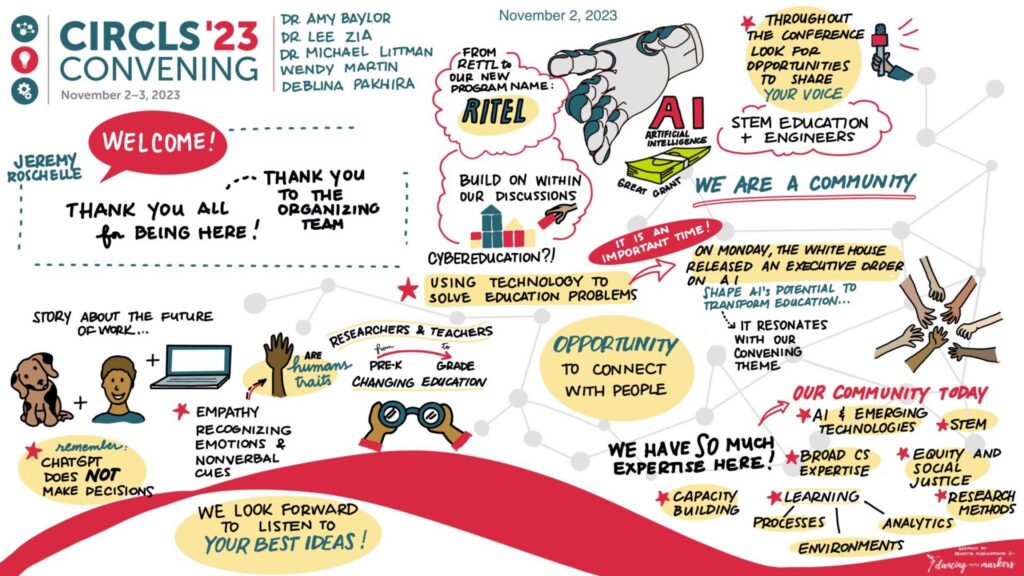
The CIRCLS’23 theme, “Shaping AI and Emerging Technologies to Empower Learning Communities,” called for attendees to prioritize educational goals and values as we design and investigate AI and other emerging technologies. Topics addressed during the convening included:
- Emerging technologies such as machine learning, generative AI, augmented reality, assistive technologies
- Advances in learning sciences methods and theories
- Equity, ethics, and related design concepts (responsible and human-centered design)
- Insights on improving learning in specific STEM and broader subjects
- Research on learning in formal educational settings and informal settings like museums
Watch CIRCLS’23 Keynotes and Plenaries
View Project Info Pages
CIRCLS’21 Convening: Remake “Broadening” in Research on Emerging Technologies for Teaching and Learning
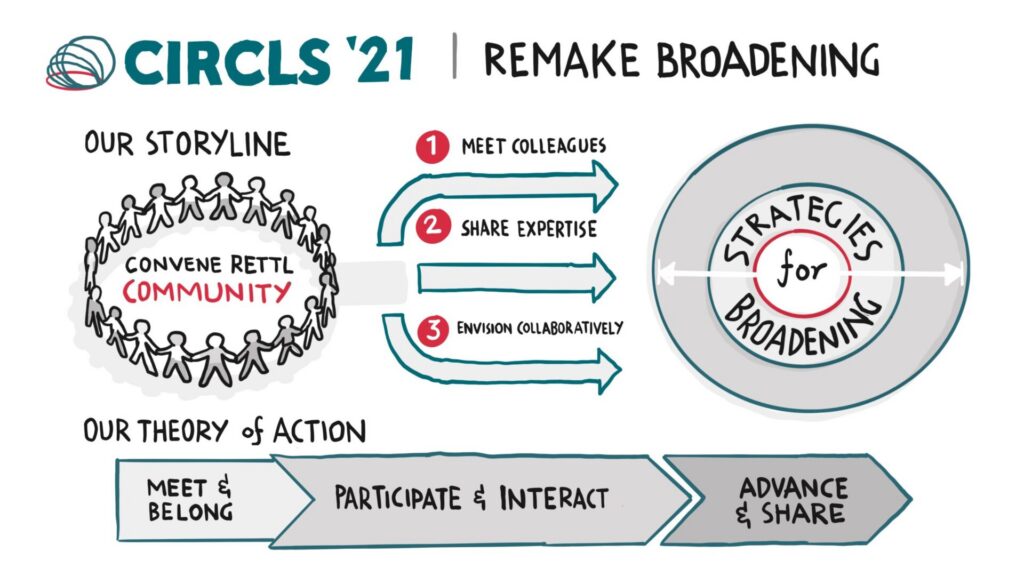
Learning technology researchers have long spoken of broader horizons, broad teamwork, broadening participation, broader impacts, and more. Our theme engaged with the importance of thinking critically and strategically about the meaning of “broad” as our field conducts future-oriented research on learning and teaching technologies.
Watch the CIRCLS’21 Convening
Watch Expertise Connections Videos
Resources
Primers
CIRCLS External Primers are brief summaries of key topics published in journals. They are used to build capacity and give people a sense of NSF Research on Emerging Technologies for Teaching and Learning’s (RETTL) main themes.
Read Primers (prior to 2020)
Read Primers (2020-2024)
Reading Lists
CIRCLS Reading Lists are curated by CIRCLS community members with expertise in a specific scholarly field or a topic significant for research on emerging technologies for teaching and learning. Readers might use CIRCLS Reading Lists as trusted starting points to gain insight into the interest areas.
Educator CIRCLS Blog Posts
These blog posts were published for people interested in the design and development of innovative learning technologies that are informed by and inform our understanding of the processes of learning.
Featured Posts
Portfolio
Project Spotlights
Project spotlights illuminated a diverse set of projects funded by NSF RETTL and other NSF programs with an emphasis on emerging technologies for teaching and learning. Spotlights provided an opportunity for community members to introduce their projects and share some context about their work with the CIRCLS community.
Read Project Spotlights (prior to 2020)
Read Project Spotlights (2020-2024)
About
The CIRCLS Team
- Digital Promise: Jeremy Roschelle (Principal Investigator), Judi Fusco (Co-Principal Investigator), Pati Ruiz, Deblina Pakhir, Dalila Dragnić-Cindrić, KellyAnn Tsai, Yenda Prado, Sana Karim
- SRI Education: Shari Gardner (Co-Principal Investigator), Sophia Ouyang
- EDC (Education Development Center): Sarita Nair-Pillai (Co-Principal Investigator), Wendy Martin, Camille Ferguson
- University of Pittsburgh: Erin Walker (Co-Principal Investigator), Cassandra Kelley, Zak Risha, Leah Friedman
- Postdoctoral Researchers: Michael Chang, Aditi Mallavarapu
- Advisors: Alina Von Davier, Kevin Brown, Cindy Hmelo-Silver, Diane Litman, Craig Watkins, Marcelo Worsley
This material was based upon work supported by the National Science Foundation under grant 2021159. Any opinions, findings, and conclusions or recommendations expressed in this material are those of the author(s) and do not necessarily reflect the views of the National Science Foundation.