


As educators working with middle school learners, we often see only what sits on the surface. We notice the observable behaviors, the reading fluency challenges, or the math assessment scores. But as Digital Promise’s senior director of Network and Programs Stefani Pautz Stephenson, Ed.D., pointed out during our recent edWebinar series, this is just the tip of the iceberg. To truly understand each learner, we have to look beneath the surface to uncover what’s driving behaviors and academic outcomes.

“When we understand learner variability through the lens of a learner, it allows us to see more of the “why” behind the behavior.”
Stefani Pautz Stephenson, Ph.D., Digital Promise’s senior director of Networks & Programs
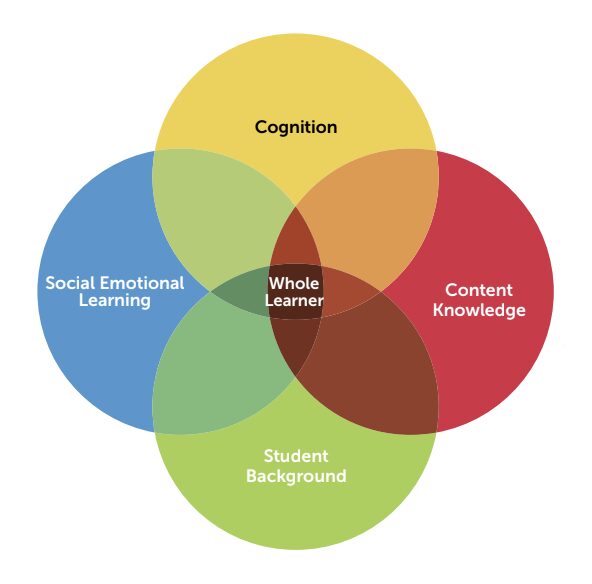 This is the core of learner variability—the understanding that every learner has a unique learning profile of strengths and challenges. To design for this variability, Digital Promise developed the Learner Variability Navigator (LVN), a free tool built upon a whole child framework, categorizing the complex factors that shape learning into four key pillars:
During three different webinars on middle school English language arts (ELA), math, and SEL, Digital Promise explored this powerful interconnectedness of learning factors and highlighted strategies for tailoring instruction to learner variability in each domain.
Hosted by Digital Promise’s Nick Schiner with Stefani Pautz Stephenson and literacy expert Dacia Toll of Coursemojo
As texts become longer and more complex in middle school, learners are asked to cognitively juggle their working memory, background knowledge, and textual evidence at the same time. When a learner struggles with this heavy cognitive load, teachers might only see the surface-level result—such as emerging motivation challenges, a vocabulary deficit, difficulties making inferences, or other immediate struggles. These challenges can result in educators misidentifying skills gaps or other environmental barriers that can impact learning. This webinar explored how educators can address this challenge by utilizing intentional scaffolds, such as chunking texts or leveraging AI-driven tools.
“What we know from cognitive science is that you [learners] actually have to productively struggle in order to acquire new learning. We also know, if it’s too great of a jump for you, then you’re just going to be frustrated, which will certainly lead to [de]motivation.”
Dacia Toll, Founder of Coursemojo
Factors Discussed
Strategies Discussed
Want to Learn More?
Hosted by Digital Promise’s Nick Schiner with Stefani Pautz Stephenson and math technology expert Erik Weitnauer of Graspable Math
Math moves from concrete to abstract in middle school, requiring more mathematical flexibility from learners and making rigid memorization less effective as a learning strategy. When a learner struggles with that need for flexibility, underlying learner variability factors may be masking true mathematical potential. This webinar examined how educators can uncover and develop this potential by designing low-stakes instruction that reduces cognitive load and fosters the positive math identity that’s essential to driving long-term engagement for each learner.
“You’ll use math wherever you go… and we really want students to get to the point where they see that math matters to them, and they feel capable of learning it.”
Erik Weitnauer, Founder of Graspable Math
Factors Discussed
Strategies Discussed
Want to Learn More?
Hosted by Digital Promise’s Nick Schiner with Sarah M. Scott, Ph.D. and Kelly McNeil, Ed.D.
The middle school years are a critical window for developing social-emotional competencies, a challenging area to address with so many learners of various skills and knowledge sets in a single classroom. Traditional instruction models can overlook learner variability, and many educators are seeking ways to specifically support their neurodiverse learners with more SEL-supportive strategies. This webinar covers how educators can create low-stakes, high-engagement environments where playful and game-based learning can address diverse cognitive and emotional needs, allowing learners to safely take risks, collaborate, and navigate complex social dynamics.
“I consider play a sort of permission… an open door to experiment. You can try out these different roles. You can experiment with leadership, conflict resolution, and things that eventually lead into real world scenarios.”
Kelly McNeil, Ed.D., Playful Learning Expert
Factors Discussed
Strategies Discussed
Want to Learn More?
This series emphasized that each learner’s observable struggle—whether in reading, math, or social dynamics—is often just the “tip of the iceberg,” masking underlying learner variabilities like anxiety, working memory constraints, or a lack of metacognitive habits. The core challenge for educators is transitioning from seeing a challenge to designing a solution that addresses the whole child.
Digital Promise’s LVN is the essential, free tool that makes this transition possible by linking actionable instructional strategies to the wide array of learner variability factors affecting learners of all grade levels. Begin designing for the whole child today by exploring the Learner Variability Navigator.

