

This story first appeared on the “When You Wonder” Substack. Subscribe to get more stories like this one in your inbox.
A dozen ideas ricocheted through Joe Winans’ brain as he sat across a table from Chef David Wood, culinary arts teacher at southern California’s La Quinta High School. Winans teaches high school chemistry at South Fayette, a Pittsburgh-area school district where educators are encouraged to try out new approaches to teaching and learning. But he’d never before flown across the country with coworkers to brainstorm with strangers.
Winans found himself exploring new questions: Instead of traditional labs, what culinary experiences could get teenagers excited about chemistry? And how might culinary students enhance their creations by discovering the science behind cooking?
A self-professed “foodie,” Winans returned to Pennsylvania invigorated. He and his co-teacher, Bryan Seybert, began dreaming up a chemistry class called “The Science of Food.” And folks at La Quinta, one of four high schools in Desert Sands Unified School District, “were already churning on using this as a way to tie together chemistry and culinary content,” Winans says.
“There’s such opportunity here to make science more engaging for students,” says Elizabeth Hartman, Desert Sands’ director of professional development and teacher support. Since La Quinta already has “an amazing culinary arts program,” she says, “it just kind of felt like a perfect fit to loop in some science conversations…It was like a beautiful little marriage.”
That conversation didn’t happen by chance. The districts connected through Digital Promise’s League of Innovative Schools and became one of several partnerships supported through “Learning Neighbor” grants.
Across the country, schools are searching for new ways to engage learners and staff. Increasingly, some of their best thinking is happening alongside peers facing similar challenges, even when communities and contexts look very different.
The League of Innovative Schools helps district leaders connect with peers nationwide to share what they’re learning, wrestle with common challenges, and explore possibilities together. It offers something deeper than simply exchanging ideas: co-creating new approaches and adapting promising practices to meet local needs.
That’s why Digital Promise—together with the Pittsburgh-based Grable Foundation—launched “Learning Neighbor” grants. The grants connect Pittsburgh-area districts (who have a significant presence in the League, with 20 of the region’s districts participating) with peers elsewhere in the country. Teams learn alongside one another, turning shared questions into new ideas and initiatives.
It’s a 500-mile drive from Connecticut’s Meriden School District to Pennsylvania’s Baldwin-Whitehall School District. But both need bus drivers, and both aim to offer students as many career pathways as possible. As Learning Neighbors, Meriden and Baldwin-Whitehall are now helping their high schoolers get certified with commercial driver’s licenses.
“If they want to come back and be our bus drivers, believe me, we will take them,” says Barbara Haeffner, Meriden’s assistant superintendent for teaching and innovation. But she and Baldwin-Whitehall’s assistant to the superintendent, Janeen Peretin, are just as excited about the other doors this license can open: Students who aim to open lawn care or home improvement businesses, or seek jobs with companies using heavy machinery, all benefit from graduating with a commercial driver’s license, Haeffner says.
Meriden and Baldwin-Whitehall have begun working to make this happen. Step one is in place: Peretin found a virtual course for the online portion of the license’s exam that students in both districts can do asynchronously. Though they won’t receive credit toward graduation, students who are 18 (or soon to be) can try this course with support from their district.
“We’ll do some tapping on the shoulders of students who may not know what they want to do, and say, ‘Hey, how about giving this a try?’” Haeffner says. “Can we support you in a study hall? Can we provide a mentor — an adult who will say, ‘OK, let me check in with you’?”
While those teens are busy studying for their commercial driver’s licenses, and others at La Quinta and South Fayette are fusing chemistry and cooking, students at 17 additional districts nationwide will also have new, engaging experiences this year because their districts became Learning Neighbors.
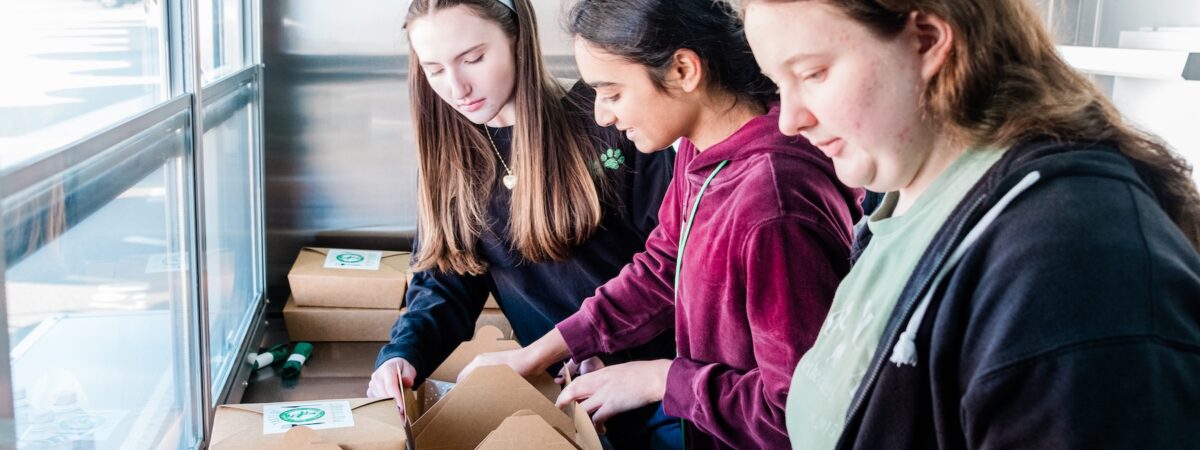
Though their challenges may differ, these districts help each other find solutions. La Quinta, for example, has a full commercial kitchen for students. South Fayette had no classroom kitchen—or even the utility hookups in a classroom to create one. But they had a faculty room that was nearly always empty, save for a teacher occasionally stopping in.
After her team’s fruitful visit to La Quinta, South Fayette’s superintendent, Michelle Miller, asked: “Am I saving a space for one break, 15 minutes a day, and for a few people to put their lunches in there, when that space could be used instructionally?”
With support from faculty who will still use the room, the district transformed it into a kitchen for chemistry labs. “Those are difficult decisions, because nobody wants a space taken away from them,” Miller says. But co-creating with cross-country partners inspired fresh thinking about how and where chemistry could be taught.
For Miller, the goal isn’t for one district to hand another a finished solution. It’s about leaders and educators bringing their expertise, questions, and local contexts to the table and developing ideas together.
“One of the things about the League of Innovative Schools that I probably appreciate most is this notion of co-creation,” Miller says. “It wasn’t me saying to Joe and Bryan, ‘I need you to create this course. This is what it needs to be.’ It was, ‘How might we?’ That invitation of, ‘OK, can you brainstorm with me?’”
All four districts found that meeting in person—even briefly—was a key to success.
“It’s not only the nerding out of the science and the project itself, but the feeling of collaborating with such great, innovative leaders that want to do things for kids,” Hartman says. “That brings me joy and fills my cup.”
Throughout this process, Hartman noticed a recurring theme: “You’re like, ‘Oh you have that problem? I have that problem! OK, first of all, we’re not alone. And second of all, how are you dealing with it?’”
Haeffner agrees: “Having the opportunity to share practices that work, or don’t work, is so beneficial to everyone in education. Thinking outside of the box and being innovative is a win-win for all of us.”

