Research and practice alike recognize the power of student-to-student discussion in a history classroom. When guided by a skilled teacher, discussions help learners think critically about history, grapple with different perspectives, and grow into active and engaged citizens. But finding time for meaningful dialogue—especially while racing through a packed world history curriculum that covers content from the Stone Age to the 21st century globally—is a whole different story.
To address this, Digital Promise, the University of Pennsylvania Graduate School of Education, and OER Project partnered with a dozen world history educators working in racially, linguistically, and economically diverse Title I high schools across eight states. Together, we co-designed Deeper Discussions in World History: a suite of open-access, discussion-based lessons and self-paced professional development modules built to help teachers facilitate rich historical inquiry through meaningful dialogue.
These materials are embedded in World History Project, a free, standards-aligned high school curriculum published by OER Project—a platform used by over 100,000 educators nationwide.
Co-design teacher Adam Esrig weighs in on the importance of deeper discussions
Every lesson is built around an open-ended CHQ that encourages genuine historical inquiry. These questions explore specific historical problem spaces and are open to multiple interpretations, serving as a primary driver for discussion after students have analyzed sources.
Every lesson is designed with a thoughtful arc of inquiry. Lessons begin with an “on-ramp” discussion that grounds abstract concepts in students’ personal lives, establishing immediate relevance and providing a meaningful lens for analyzing the historical material. Lessons conclude with an “off-ramp” reflection, which guides students in connecting their new historical insights back to their own perspectives and the broader world.
The lessons prioritize the use of sources that are both compelling and comprehensible. Extensive effort was put into finding authentic accounts—often beyond typical resources—and tailoring them for high school reading levels through careful selection, cutting, and scaffolding, ensuring students have what they need to engage in meaningful dialogue.
To ensure high-quality discussion, the lessons include a robust array of embedded teacher supports. These tools guide educators through common challenges, including clear pacing guides, discussion norms, facilitation probes to keep dialogue on track, student goal-setting prompts, and reflection strategies to consolidate learning.
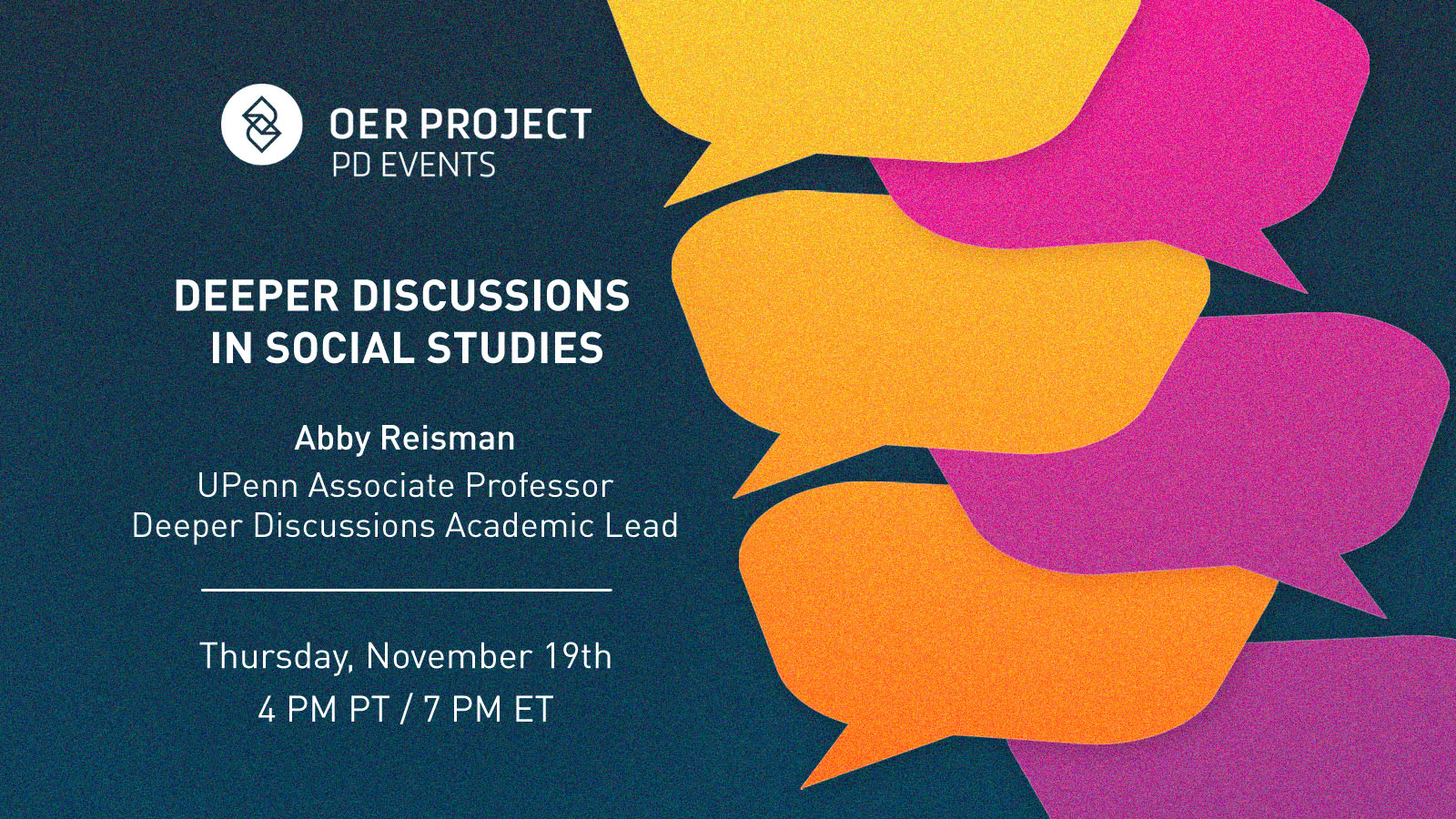
November 19, 2026 at 7 p.m. ET
Led by Professor Abby Reisman (UPenn) and Maya Jonsson, who teaches in Philadelphia, Pennsylvania, this workshop focuses on how to make meaningful discussions happen. You’ll look at discussion moves, structures, and strategies that help students listen closely, respond thoughtfully, and build ideas together.

The creation of these materials was supported by the Institute of Education Sciences, U.S. Department of Education, through Grant R305A220457 to Digital Promise. The opinions expressed are those of the authors and do not represent views of the Institute or the U.S. Department of Education.