This article originally appeared on Usable Knowledge from the Harvard Graduate School of Education. Read the original version here.
When Professor Jal Mehta and then-doctoral candidate Sarah Fine embarked on their exploration of deeper learning in American high schools, they were initially disappointed. They’d traveled to California to visit a school known for its rich, engaging instruction — but many of the classrooms they visited were far from inspiring. If deeper learning wasn’t the norm here, they wondered, where was it?
After talking to 350 students, educators, and parents across 30 schools, they found few schools where powerful learning, in which most students were engaged and thinking critically, was happening across the board. However, they did find individual teachers who were making it happen on their own. In those classrooms, students were enthusiastically engaged, participating in challenging tasks that drew on their analytical and problem-solving skills. Mehta and Fine describe these bright spots in their new book, In Search of Deeper Learning: The Quest to Remake the American High School.
Usable Knowledge sat down with Mehta and Fine, who is now the director of the teaching apprenticeship program at the High Tech High Graduate School of Education in San Diego, to find out how other teachers can replicate the successes they uncovered — and how to prepare teachers to facilitate the kind of deeper learning we’d hope to see in every setting.
You note in In Search of Deeper Learning that high schools are often considered the “the last and most challenging frontier of education reform.” People fear that by high school, some students have just fallen too far behind. But you saw deep learning in schools where the test scores might suggest that students are working below grade-level. How can good teachers facilitate “deeper learning” in high school, even when students are behind?
Mehta: Kids often can think and discuss in more sophisticated ways than they can write, if they are behind in their skills. Teachers found ways to ask questions at the level that those kids were thinking about things, which were often quite sophisticated, rather than focusing on where they were behind.
Fine: They were trusting that adolescents, regardless of what skills or knowledge they may not yet have gained, are capable of complex thinking; that they’re brains are ready for it, and that they’re eager for it, and they’ll rise to the challenge if they’re given the right support. They were adding opportunities for skill-building inside of interesting work that has consequence, and meaning, and opportunities for creativity. It’s not mutually exclusive for work to be powerful and interesting, and also building skills. Having tried to do that a bit myself, it’s really hard. It takes a lot of deliberate thinking and crafting of tasks. But, where we saw it, it was just night and day.
You also focus on extracurriculars as a space where deeper learning happens. What can we learn from what happens after school?
Mehta: With adolescents in particular, we are often working against their desires to contribute, to be responsible, to be productive people. That’s part of why we were so taken with the extracurricular space and the club spaces: those spaces assume that students will be leaders, students will learn from other students, that students can make real things.
One of the things great teachers were able to do was bring a logic of apprenticeship to their students, allowing students to play the whole game at the junior level, thereby enlivening the classroom experience and giving students the sense that their work mattered. It was especially hard to find math teachers who were able to do this.
Why do you think this is? What are great math teachers doing?
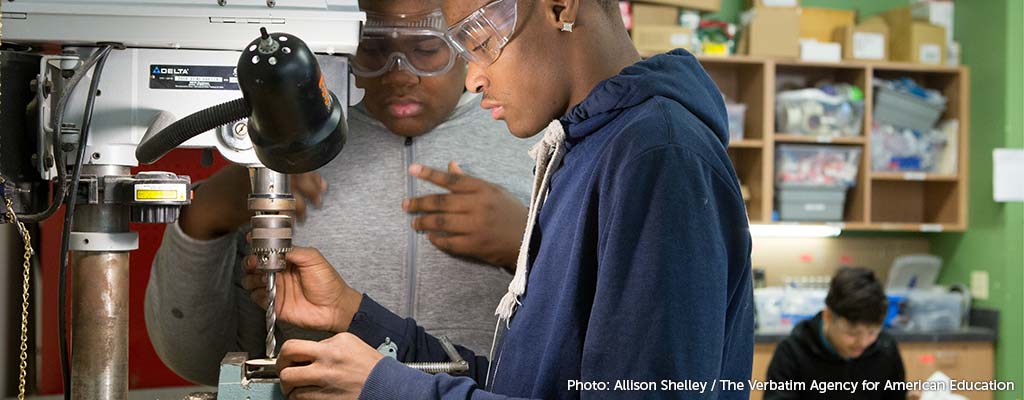
Fine: Pure mathematics as a field is shrinking dramatically even as fields that are math-related, like engineering, are growing. But the kind of math that students often are doing in school is often some approximation of pure mathematics, rather than applied mathematics, and that’s not something that very many teachers have ever done in the world, nor that many people in the world do anymore. The more promising math lessons we saw were often ones where there was an engineering component or robotics or some kind of connection to more applied math scenarios.
How can we train more great teachers?
Fine: My current role is designing and running a teacher-preparation program, so I think a lot about this. I think the most important change we could make is to make sure that the structure and logic of teacher training is mirroring and giving candidates experiences of the kind of learning that we’re trying to get them to create in a classroom, right? If we’re trying to teach teachers to treat students as sense-makers, but we just constantly talk at them, there’s a lot of dissonance there. We fast-track a lot of teachers in the U.S. and put them in classrooms very quickly. The longest preparation programs we have are usually around a year.
If you don’t have an instamatic mode of training people, and then there’s no systematic support from professional learning when people get to schools, then what you’re going to witness is what we saw: highly variable instruction; some really great teaching and other people who would like to be doing that kind of teaching but don’t quite know how. – Jal Mehta
Mehta: I think on that point — would it take longer for teachers to become deeper teachers, or whatever you want to call it? And I think the answer to that is sort of yes and no. What we witnessed was the result of a non-system. If you don’t have an instamatic mode of training people, and then there’s no systematic support from professional learning when people get to schools, then what you’re going to witness is what we saw: highly variable instruction; some really great teaching and other people who would like to be doing that kind of teaching but don’t quite know how. I think we could lessen the learning time, if we were much more intentional at apprenticing new people to really skilled people who already knew how to do the work. But it would still take time.
Fine: We are nowhere near bumping up against the limits of what we could do with novice teachers if we could actually had a system to train them well.
How to Promote Deeper Learning in your Classroom
-
- Think of your students as apprentices. The great teachers profiled by Mehta and Fine are inducting their students into the art or science — or combination thereof — of their individual disciplines and allowing students to learn by working in that domain. Rather than taking multiple choice tests about their reading, an excellent philosophy teacher was having the students co-explore texts with him as philosophy scholars. A team of math teachers had teachers develop their own theories for questions like how many breaths it would take to blow up a balloon, making meaning like a mathematician rather than relying on predetermined formulas. Students were empowered by this logic of apprenticeship, and the expectation that they, too, could be experts, applying their knowledge as they saw fit. Fine and Mehta think about this in terms of allowing students to develop mastery (knowledge and skill); identity (connection to a subject), and creativity (using their understanding for work they find meaningful).
- Focus on depth over breadth. The great teachers Fine and Mehta observed emphasized going deep into a topic rather than covering a broad range of topics. That can be easier said than done, especially for subjects like history or math, where there’s pressure to get through specific content before the end-of-year state test. Rather than rushing through lectures and worrying about falling behind, the great teachers Mehta and Fine saw “were more concerned with whether students were adopting the habits and dispositions of inquirers in their disciplines.” The researchers noted that the teachers were able to do this by distancing themselves from testing pressures. Admittedly, that was often through routes not available to all teachers, like teaching an elective, or moving to a school with a compatible philosophy. But sometimes, teachers were able to get the freedom they required for deeper learning by making a strong case to principals, often bolstered by satisfied students and parents.
- Give up some control. Rarely does deeper learning happen when a teacher spends the entire classroom lecturing from the front of the room, Fine and Mehta found. By allowing students some choice in the topics they explore and the methods they use, teachers can let students see the purpose in their learning and be more engaged.
This article originally appeared on Usable Knowledge from the Harvard Graduate School of Education. Read the original version here.