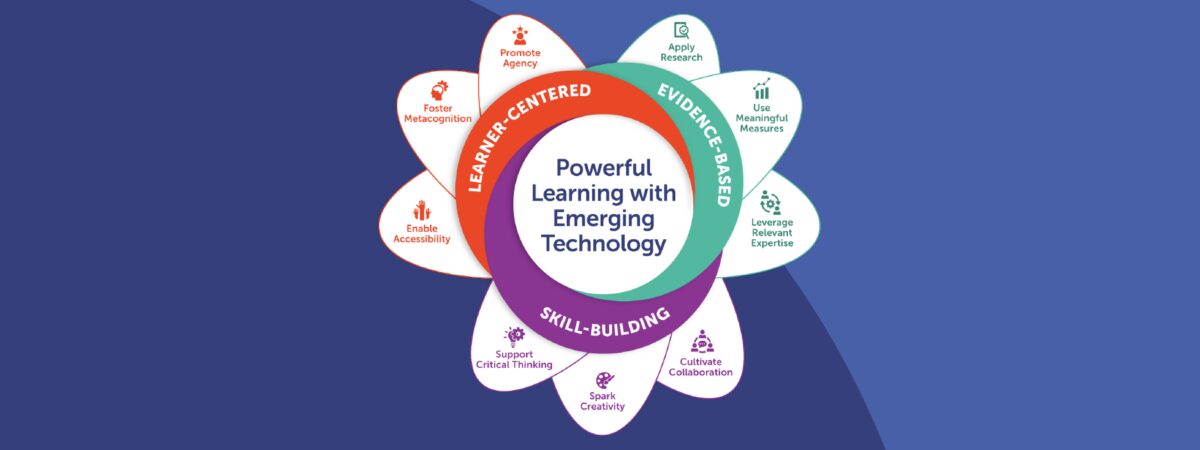


To develop the framework, we interviewed more than 50 experts across the field, collaborated with a working group of 10 distinguished professionals, and conducted a literature review to ground the topics that surfaced in research-based insights. These activities led to the identification of key principles, practices and strategies to design and implement technology for powerful learning.

The framework and related position paper offer research-based insights and practical strategies for designing and implementing emerging technologies to promote powerful learning by ensuring tools are evidence-based, learner-centered, and skill-building.
“The future of learning is about more than just technology—it’s about bringing together research, practice, and innovation to create opportunities for every student. AI has the potential to unlock new ways of thinking, create more equitable learning environments, and help every student reach their full potential. As a district, we are committed to using AI in ways that are ethical, transparent, and student-centered, ensuring that every learner has the tools they need to succeed in an ever-changing world.”
Mario J. Andrade, Ed.D., Superintendent
Nashua School District
Evidence-based tools apply educational research to inform the design, implementation, and iterative improvements of emerging technologies. We offer three practices to design evidence-based tools:
“You can’t brute force AI into the classroom and expect it to work.”
Sara Kloek, Vice President of Education and Children’s Policy
SIIA
Learner-centered tools promote agency and metacognition in ways that are accessible for all learners, building upon learners’ strengths so that every learner has the opportunity to fully engage, learn, and thrive. We offer three practices to design and implement learner-centered tools:
“If you continue to be left behind slowly, one class after another, that has dire consequences for your future. It may be that you’re extremely brilliant, you just don’t learn the way the teachers happen to be teaching. I think that one of the greatest promises of AI is the ability to personalize and customize instruction for students and really level the playing field.”
Pete Just, Project Director for AI
COSN
Skill-building tools prepare learners to be successful in our world by enhancing uniquely human skills, such as critical thinking, creativity, and collaboration, alongside a deep understanding of academic content. We offer three practices to design and implement skill-building tools:
“In Catawba County Schools, we recognize that for GenAI to serve as a meaningful learning partner, our users must understand how these tools operate, the data they are trained on and the potential risks involved. When our students and staff clearly understand how GenAI works, they can engage with it more critically, make informed decisions and feel more in control of their own learning. Trust in these tools can empower our users in their learning experiences instead of feeling like passive consumers of information.”
Marty Sharpe, Chief Technology Officer
Catawba County Schools
We’re hosting a three-part webinar series diving into each of the principles.
Evidence-based Design
Monday, Jan. 12 at 9:30 a.m. PT/12:30 p.m. ET
Presenters: