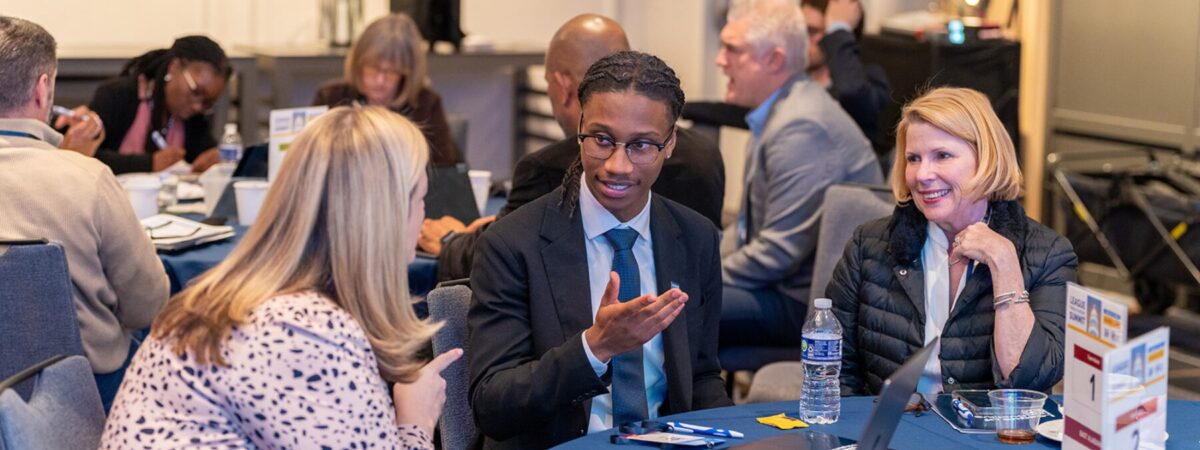


Before the 2025 Policy to Action Summit hosted by the League of Innovative Schools and the Alliance for Learning Innovation in Washington, D.C., I thought of myself simply as a student doing what students are supposed to do—going to school, working hard, and taking advantage of the opportunities in front of me.
Being in rooms with district leaders, policymakers, researchers, and funders changed that understanding completely.
For the first time, I saw how much effort, coordination, and advocacy happens before students ever benefit from innovative programs. The experiences I have had in school did not appear by chance. They were the result of adults who believed students were worth investing in long before outcomes were guaranteed.
That perspective shift became my biggest takeaway from the summit.
As a student at Lincoln High School in Alabama, part of League district Talladega County Schools, I experienced innovation from the inside. Dual enrollment, industry credentials, and internships felt normal to me.
At the summit, I learned how rare that actually is for students from rural areas to have access to such opportunities.
I listened as leaders discussed what it takes to change policy and secure federal funding support—aligning systems, navigating constraints, building coalitions, and making the case for sustained investment. Those conversations made one thing clear to me: policy is not distant from students. It determines who gets access to resources, when, and for how long.
Seeing that process firsthand gave me a new respect for the people who advocate on our behalf so students never have to see the barriers behind the scenes.
One of the most important lessons I took away is that students cannot benefit from opportunities that policymakers don’t prioritize.
The programs that shaped my education existed because adults were willing to speak up for students who were not yet in the room. They understood that investing early, especially in rural and underrepresented communities, creates outcomes that compound over time.
The results of that advocacy go far beyond credentials or coursework. They show up in confidence, identity, and belonging. When you invest in people, progress follows, and I am living proof of that.
—Seth Walker
When friends and family learned I was traveling to Washington, D.C., many were surprised. Some asked, “Why you?”
I grew up in a rural, country community where opportunities like this were not common and rarely imagined. For much of my family, leaving the state, let alone speaking on a national stage, was something that simply had not happened before. Education was about working hard and getting by, not about shaping policy or influencing national conversations.
That reaction made something clear to me.
There is not just a gap in resources across communities. There is a gap in imagination and impact. There is a gap in the tools, exposure, and belief that allow students to picture themselves in rooms they have never been told they belong in.
Access does more than open doors. It expands what students believe they are capable of. When one student steps into those spaces, it begins to change what an entire family and community believes is possible.
Student Seth Walker delivers a keynote speech and meets with congressional staff and leaders at the League of Innovative Schools’ 2025 Policy to Action Summit in Washington, D.C. Seth elevated how essential federal investment in locally-led R&D is through his powerful testimonial and lived experience.
—Seth Walker
Before the summit, I thought of education research and development (R&D) as reports, metrics, and long-term studies.
And to be honest, I didn’t understand every funding formula, policy lever, or data model that was discussed. But what I do understand, and what I am completely sure of, are my lived experiences as a student.
My experiences taught me that education R&D also looks like listening to students, families, and communities. Students are not just participants in innovative systems. We are evidence of whether those systems work.
When student voice is included early, programs adapt faster, serve learners better, and last longer. I know this because I lived inside systems that were intentionally designed, funded, and sustained through an investment in education R&D. With the Competitive Edge: An Action Agenda for How School Systems Can Advance Learning Through R&D, developed by the District Education R&D Advisory Committee, students from rural communities like mine and beyond can benefit from systems that center their lived experience and expertise in innovation.
The advisory committee’s vision for embedding R&D in the way schools improve, adapt, and lead echoes what I saw work in my education—it’s what created the conditions for students like me to access opportunities that changed our life’s trajectory.
If there is one belief I hope readers take away from this experience, it is this: students are not the end of the innovation process. They are the reason it exists.
When leaders advocate for inclusive, student-centered policy and funding, the results go far beyond programs or pilot initiatives. They show up in lives changed in ways statistics can never fully capture.
My hope is that more decision-makers continue to invest in environments where students do not just benefit from innovation, they are an essential part of it. Together, we can create a world where more learners—like me—become living proof of what is possible in the future of education.
The District Education R&D Advisory Committee—supported by a partnership between Digital Promise and the Alliance for Learning Innovation—brings together district and charter leaders from across the country. Together, these leaders designed a first-of-its-kind roadmap for education research and development (R&D) that reflects local priorities and drives evidence-based solutions.


