

Crawl, Walk, Run: A Teacher's Roadmap for AI that Puts Students in Charge – Digital Promise

Crawl, Walk, Run: A Teacher’s Roadmap for AI that Puts Students in Charge

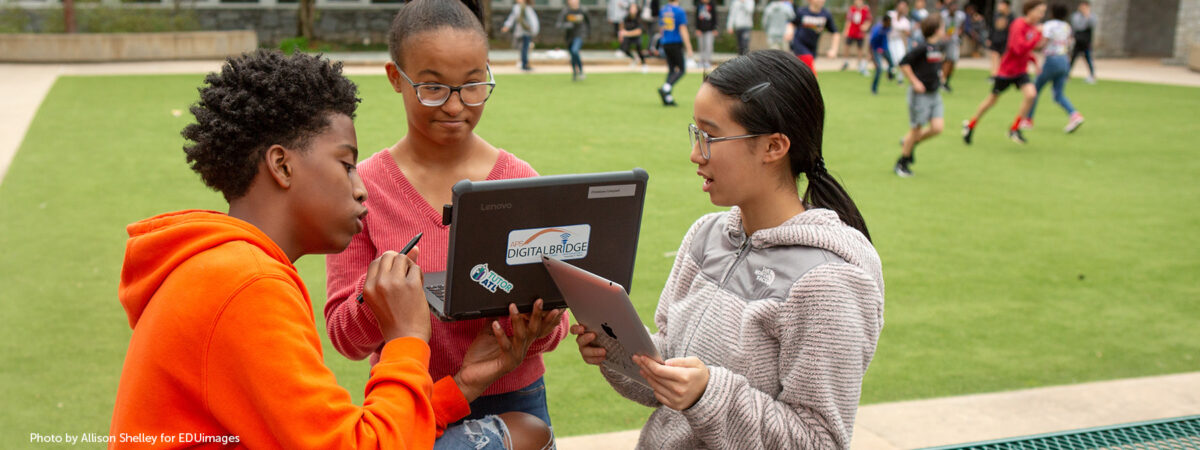
Three eighth-grade students work together on an assignment in a school courtyard.

February 10, 2026 | By

Key Ideas

  • An Instructional Specialist from Indian Prairie shares a proposed Crawl, Walk, Run framework for AI integration that helps teachers meet students where they are and grow alongside them.
  • Students learn to treat AI outputs as rough drafts to be sculpted, not answers to be trusted, building key skills of verification, iteration, and critical judgment.
  • Teachers shift from primary source of knowledge to facilitator of critical inquiry, and assess how students think with AI, not just what they produce.

The Philosophical Foundation

For years, our school community, in partnership with Digital Promise, has been dedicated to the Computational Thinking (CT) Pathways initiative. Over the past eight years of the Pathways initiative, we have taught students to think of themselves as builders, mastering the technical skills to construct solutions. Today, that foundation serves as the blueprint for the next frontier: artificial Intelligence (AI). This shift is not a departure from our previous work but rather its natural evolution, as students move from builders into creative architects who apply human judgment and vision.

To support this transition, Indian Prairie School District proposes the Crawl, Walk, Run framework as a roadmap for AI integration. The framework is not a fixed, linear sequence, but a set of interrelated instructional practices that educators draw upon with intention. Teachers and students shift dynamically across the Crawl, Walk, and Run practices, revisiting each with greater depth as learning demands evolve. Think of it as a developmental spiral: growth is defined not by progression through fixed stages, but by the deepening quality of human decision making within AI-supported environments.

Within this framework, the teacher’s role shifts from sole source of knowledge to facilitator of critical inquiry. We no longer focus solely on the final answer. Instead, we prioritize the developmental journey by valuing the integrity of the underlying logic, the quality of human-AI interactions, and the injection of human creativity to ensure a deliberate and ethically responsible process. This holistic approach recognizes that true value lies not in the output itself but in how it was built, why it works, and its ultimate impact. Just as students once learned to debug code, they are now learning to “sculpt” AI outputs by carefully chiseling away at generic logic and missing perspectives to uncover the unique and creative truth that only a human can author.
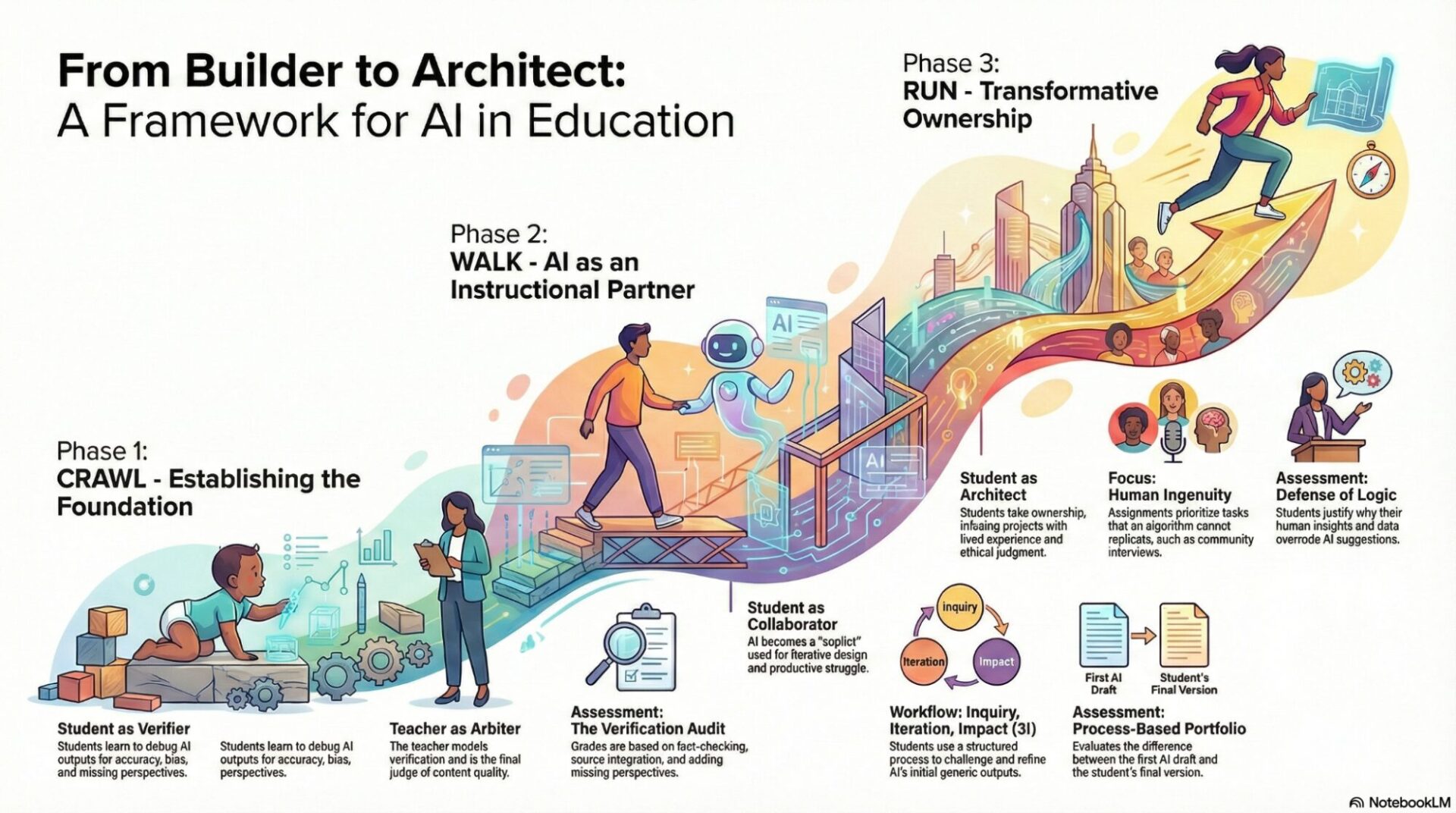
Infographic titled "From Builder to Architect: A Framework for AI in Education" showing three progressive phases. Phase 1 (Crawl - Establishing the Foundation) depicts a child with building blocks, emphasizing students as verifiers who debug AI for accuracy and bias, with teachers as arbiters of content quality. Phase 2 (Walk - AI as an Instructional Partner) shows a figure walking alongside an AI robot toward a cityscape, with students as collaborators using AI for iterative design, assessed through verification audits and a workflow of inquiry, iteration, and impact. Phase 3 (Run - Transformative Ownership) illustrates figures running dynamically forward, with students as architects who infuse projects with lived experience and ethical judgment, focusing on human ingenuity tasks AI cannot replicate, assessed through defense of logic where students justify why their insights override AI suggestions.

Indian Prairie’s proposed Crawl, Walk, Run framework for AI in education, focusing on developing student agency alongside AI tools. Image generated using NotebookLM.

Phase 1: Crawl – Establishing the Foundation

In the Crawl phase, students are new to AI-supported work and need significant scaffolding. They are learning to evaluate AI outputs for accuracy, a foundational habit that requires consistent teacher modeling. Teachers act as final arbiters, both instilling and demonstrating the consistent practice of verifying AI outputs for accuracy and underlying bias before any such content is integrated into a paper or project. By modeling this approach, teachers help students learn the critical discipline of subjecting AI outputs to human verification, rather than blindly trusting the machine. This is the foundational layer of human-centered instruction, ensuring that the machine’s efficiency never overrides human verification.

Instructional Example: A history teacher initiates a lesson on Westward Expansion by using an AI tool to generate a summary. The teacher projects this AI output and guides a “debug” session with the class. Students collaboratively analyze the text, identifying factual errors and significant omissions, particularly the lack of Indigenous populations’ perspectives. Subsequently, students transition into the roles of editors and historians. Using the AI text as a starting point, they focus on rewriting the narrative from the neglected Indigenous viewpoint. This task requires them to verify the AI information for historical accuracy using books and credible databases and then apply their own creativity and integrate accurately researched information to produce a historically comprehensive and creatively reimagined narrative.

Assessment Shift: In this phase, the assessment shifts from evaluating a polished final product (e.g., a standard essay) to evaluating the quality of a student’s critical engagement with AI. Teachers assess analytical rigor; their ability to “fact-check” the AI output, their skill in integrating non-AI evidence (books, primary documents) and their own creativity.

Phase 2: Walk – AI as an Instructional Partner

In the Walk phase, students are ready to work alongside AI with greater independence, but still benefit from structured protocols and educator support. AI evolves into a collaborative copilot, mirroring the iterative design process familiar to Computational Thinking. Our goal is to move beyond verification and ensure students are using AI as a thought partner rather than as a means to offload their own critical thinking. By encouraging a state of productive struggle, we ensure students remain the active drivers of learning while the technology serves as a support in the design process.

Instructional Example: To make this collaboration visible, we utilize the “3I” Workflow:

  • Inquiry: Students prompt the AI to generate a starting blueprint. For example, ninth grade students are tasked with designing a human-centered social media app. They first ask the AI chatbot to pitch a standard, profit-driven app. The AI generates a generic plan full of common features like infinite scroll and targeted ads. This gives the students a baseline to work from.
  • Iteration: This is where the productive struggle comes in. Students analyze the generic AI-generated plan and identify the human costs. They research the impact of screen time on mental health and then creatively redesign the app’s features. They input their ideas to the AI chatbot and engage in a conversation with it, challenging their ideas and responses. This back-and-forth interaction forces students to strengthen their argument by engaging in a dialogue with the AI-enabled tool.
  • Impact: Students evaluate the authenticity of the final product, ensuring it is a structurally sound argument infused with their unique human voice.

Assessment Shift: Assessment in this phase moves to a process-based portfolio. Students submit a log that documents their prompt iterations and alongside their human-AI markup. Teachers evaluate the creative delta; the measurable difference between the first AI draft and the final student-refined version. They look at what the student kept, what they changed, added or deleted. As in the Crawl phase, the focus of this assessment shifts from product to process.

Phase 3: Run – Transformative Shifts

In the Run phase, learning becomes transformative as students take ownership of the digital landscape through human-centric assignments. By prioritizing assignments that require lived experience, ethical judgment, and creative ingenuity, teachers ensure students provide the essential human content and details that an algorithm cannot replicate.

Instructional Example: In a Civics class, students are tasked with designing a strategic campaign to increase local voter turnout.

  • Inquiry: Students use AI to analyze historical data and identify precincts with low participation.
  • Iteration: Students gather qualitative lived experience data by interviewing local community members. They then use the AI to draft outreach messaging, but they creatively and ethically debug it by interrogating the tool’s training data for cultural gaps and infusing local, creative solutions that only a community-based, human-centered approach can generate.
  • Impact: The result is a community voter mobilization plan powered by student-verified interviews and ethical auditing.

Assessment Shift: Assessment culminates in a “defense of logic” presentation. Students must justify why they overrode certain AI suggestions, demonstrating how their creative vision and lived experience data corrected the machine’s demographic biases. The grade is based on the student’s critical judgment, creative ingenuity, and cultural awareness rather than the algorithmic output alone.


From Builders to Architects

Our journey through CT Pathways has taught students how to think like builders, mastering the logic of the digital world. Now, we are teaching them to be the architects who will design its future. By moving from Crawl to Run, and shifting our assessments to value human reasoning and creative vision, we ensure our students graduate as the ethical, critical, and culturally aware leaders of a digital future.

Sign Up For Updates! Email
Loading...