


What does edtech research look like in the era of AI and emerging technologies?
As excitement about the potential role of AI and emerging technologies in learning continues to grow, developers, researchers, and education leaders need to keep those that edtech is ultimately serving—the learners—at the center of conversations around product design and implementation. Lately, we have been exploring how to move beyond the hype and think about the myriad tensions that arise when designing and leveraging tools for the explicit benefits of learners. And importantly, how are experts centering the voices of learners throughout each decision they make about these new technologies?
In our recent webinar, we explored strategies to answer this question with Susanna Loeb, professor and director of the SCALE Initiative at Stanford University, and Dr. Mauro Nicolao, director, data science at AI Labs Curriculum Associates.
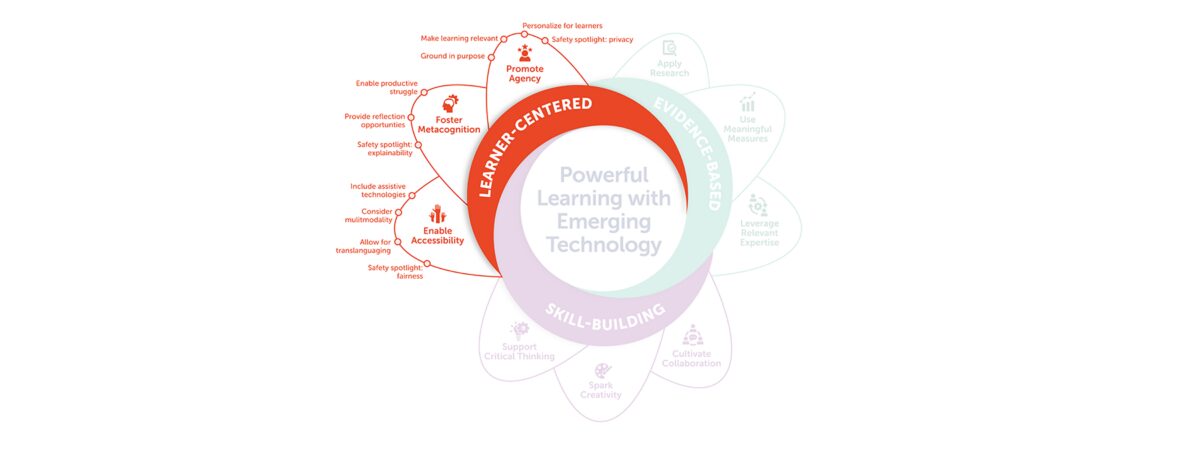
For each unique learner to thrive, edtech tools must account for the diverse range of learners who will interact with the product. AI and emerging technologies give rise to the possibilities of personalizing instruction, increasing relevance, and adding purpose to lessons to maximize each learner’s strengths. This customization can give students control over their learning and new entry points to engagement. At the same time, creating this agency must not come at the cost of learners’ privacy. In the webinar, we explored what meaningful choice actually looks like in practice and how autonomy can build learners’ skills.
Loeb spoke about how enabling meaningful choice for learners is not just about letting students pick the topics they find interesting, but also giving them the time and flexibility to slow down and explore ideas more deeply or move quickly when they are ready. That level of autonomy is engaging for students and helps build the skill of making choices. AI-enabled tools have the potential to provide this autonomy at scale in ways that traditional classrooms cannot.
Developing metacognitive skills requires intentional opportunities for learners to practice those skills. While AI and emerging tools can reduce cognitive load and make learning more engaging, they risk removing the productive struggle needed for learners to build their self-regulation. Developers must build in opportunities for learner reflection, and education leaders should incorporate these into instructional design to help learners understand how they learn. In the webinar, panelists shared insights about how they approach the balance between productive struggle and ease of use.
From a developer’s standpoint, Nicolao spoke about easing the cognitive load where there is no knowledge assessment, like the user interface, and encouraging growth in content areas, like setting adaptive goals in an AI system. He also stressed the importance of including educators in the decision making of finding the balance between productive struggle and ease of use and giving the teacher the autonomy to decide the best level of struggle for each learner.
Each learner faces barriers to learning, but some barriers, like dyslexia, dyscalculia, and cultural or language barriers, preclude full engagement in learning without targeted accessibility measures. AI and emerging technologies have the potential to remove these barriers, and with this new power, developers have a responsibility to create tools that allow each unique learner to thrive. By including assistive technologies, like text-to-audio and transcription features, including multimodality, and allowing for translanguaging, developers are beginning to ground product design in accessibility. In the webinar, we explored how developers can continue to push on design for nuanced accessibility needs, and what education leaders can look for as signs of intentional design when selecting a new tool.
Accessibility, in Nicolao’s view, is not something developers add on to a product but the first thing they consider from the initial design. And during that beginning phase, they should be talking to the communities the design choices will directly affect. Co-design, empathy sessions, or investigation are one of the most important pieces in design. He also highlighted that there is no “average learner”—every learner is different and requires a slightly different approach. Designing for accessibility means that each unique learner has a better experience with the tool, or as Loeb says, “you can’t get effectiveness without accessibility.”
Loeb also underlined the importance of evidence when it comes to accessibility. To achieve true accessibility, tools need not just pilot testimonials of lab use, but real evidence of use in diverse settings with different grade levels, student populations, staffing models, and other variables in real-world settings. And when testing accessibility, the design must be undergirded by learning sciences and grounded in the real needs and constraints of educators.
To see the full conversation, watch the webinar recording here.

