
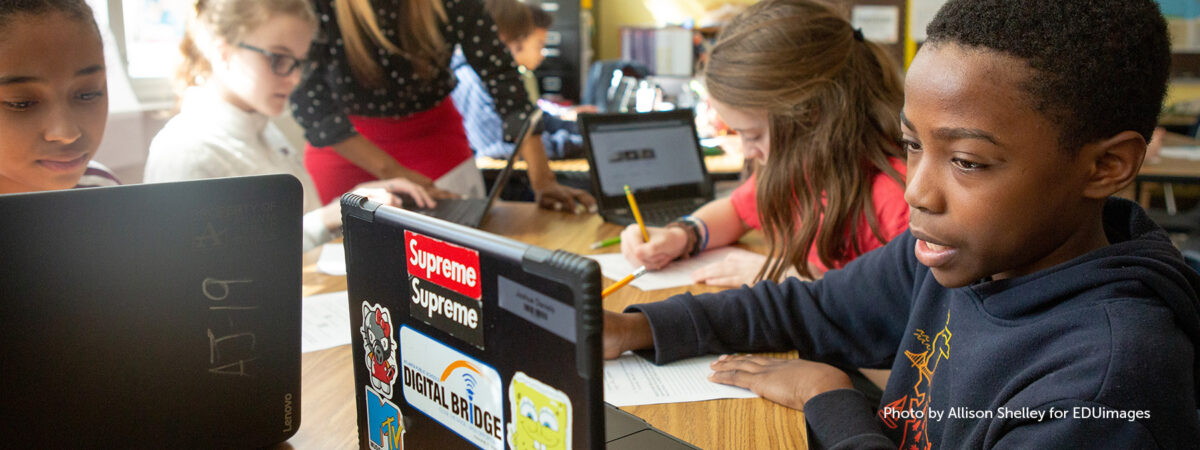


For many, technology integration in the classroom can look like: a teacher casting a presentation onto an interactive smartboard; students collaborating in a shared file to create a project on their tablets; or even independent learning on a tablet that reflects a student’s current skillset. While teaching students to understand and integrate technology is critical, these efforts are most often seen in the “core classes” of math, reading, science, and social studies.
At Dove School of Discovery in Tulsa, Oklahoma, we see a different story. The Verizon Innovative Learning Schools (VILS) program is helping Dove School educators like VILS Instructional Coach Jo Ann Honey and Art/STEAM Teacher Jacqueline Lanning dig in even deeper. These educators are helping their students move beyond passive observation and toward active participation. And by expanding technology beyond the core subjects and into art classrooms, the school is redefining what it means to be a creator in the digital age.
Before technology can expand, it’s critical that educators have a firm grasp of how it can and should foster learning. This foundation work at the Dove School of Discovery was sparked by Digital Promise’s Learning Experience 2 (LX2), a professional learning opportunity for educators that examine the characteristics of collaborative and constructive learning enhanced by technology.
Through professional learning opportunities such as live sessions, self-guided exploration, coaching, and feedback from their colleagues and Verizon Innovative Learning Schools coaches, teachers co-designed instructional shifts to increase student collaboration. They did this by redesigning lessons using tools, templates, and strategies that promote collaborative learning in the classroom. Overall, educators learned to visualize a classroom where students can use technology to guide their own learning journey.
Jo Ann Honey noted that the experience clarified what effective, high-quality, student-guided collaboration can look like in practice.
“It’s allowed us to give more power to the students… it empowers them to be more responsible for their learning than us talking at them.” — Jacqueline Lanning
Technology is more than just a learning tool – it is a powerful, transformative pedagogical partner that enhances human interaction rather than replaces it. The Dove School of Discovery builds upon this ideal, not just in the core subjects, but across the board. The art room has become a laboratory for this shift. The Dove School of Discovery’s art classrooms are full of students using tech-based tools like Makey Makey. Students turn 2D sketches into interactive pieces that produce sound and light. Younger students are creating rubrics to follow when 3D printing, building their leadership skills. Projects like researching and designing custom Pokémon or Yu-Gi-Oh! cards require students to engage in reading, writing, and math to determine character “power bases” and descriptions.
“[Students] have these light bulb moments… [they] love the tech integration enough to go from point A to point D or F before I even said another word.” — Jacqueline Lanning
The success at Dove School of Discovery demonstrates that when students are given the power to lead their technology use, they become more motivated and responsible for their own education, as Mrs. Honey reiterated, “Working to empower the teachers through the VILS learning opportunities in turn empowers the students in ways that will greatly affect their futures.”
By providing the pathway and the tools, educators can transform the classroom into a space of constant “light bulb” moments where students inspire one another.
Want to know more about fostering student agency through technology? Find more resources on the Powerful Learning landing page.

