
Teacher voice is essential as we explore using portfolios as a means of assessing Portrait of a Graduate competencies. While instructional leaders had already indicated interest in a portfolio approach to collecting, analyzing, and sharing student competency growth, we knew we needed to more deeply understand the teacher experience with portfolios. We met with teacher leaders in two of our elementary schools to get their feedback about portfolio implementation. Below is what we learned from teachers that are trying a portfolio approach.
Teachers have a lot on their plate. It is well-documented that the burdens placed on classroom teachers can feel unmanageable and lead to burnout. Therefore, it is important to not make portfolios a top-down mandate. In the schools we talked to, portfolios were introduced as an option to try. Teachers (often a grade level team) agreed to try out portfolios and determine their value to student learning and provided feedback to the leadership team about what was working, what needed adjustment, and what support they needed. These early adopters really emphasize the importance of this approach, explaining how the initially resistant teachers will respond to what other teachers say, “those other teachers see that students know how to do it and are asking for it [using the portfolio], it’ll be easier to bring those other teachers along.”
The teachers we talked to had gone into the portfolio work trepidatiously. Would this add more work? How much support would students need? What would be the value add? In these schools, the answers were: not much, not much, and a lot! One teacher shared, “When they first said, online portfolio, I thought ‘This is over the top.’ But I love it, it’s on my phone. It’s really easy.” Not only did the teachers share they found it easy, but they saw a shift in student ownership which made the portfolio adoption rewarding. Another teacher comments that,
“[Students have] more ownership to learning, they know there is a project and they want to show it off and memorialize it.”
One school we talked to was trying a digital portfolio tool and one school was using folders. Both sets of teachers suggested a simple approach, with a three-step protocol and spending time upfront training the students. One teacher gives students three sticky notes. Students place the sticky notes on one thing they are proud of, one thing their teacher said to add, and one thing they could work on. Another teacher had students add three things from each math unit: a cool down, one checkpoint, and the unit assessment. Teachers shared that while the first portfolio submissions were somewhat time consuming, ensuring students understood the routine early on, led to smoother processes down the road.
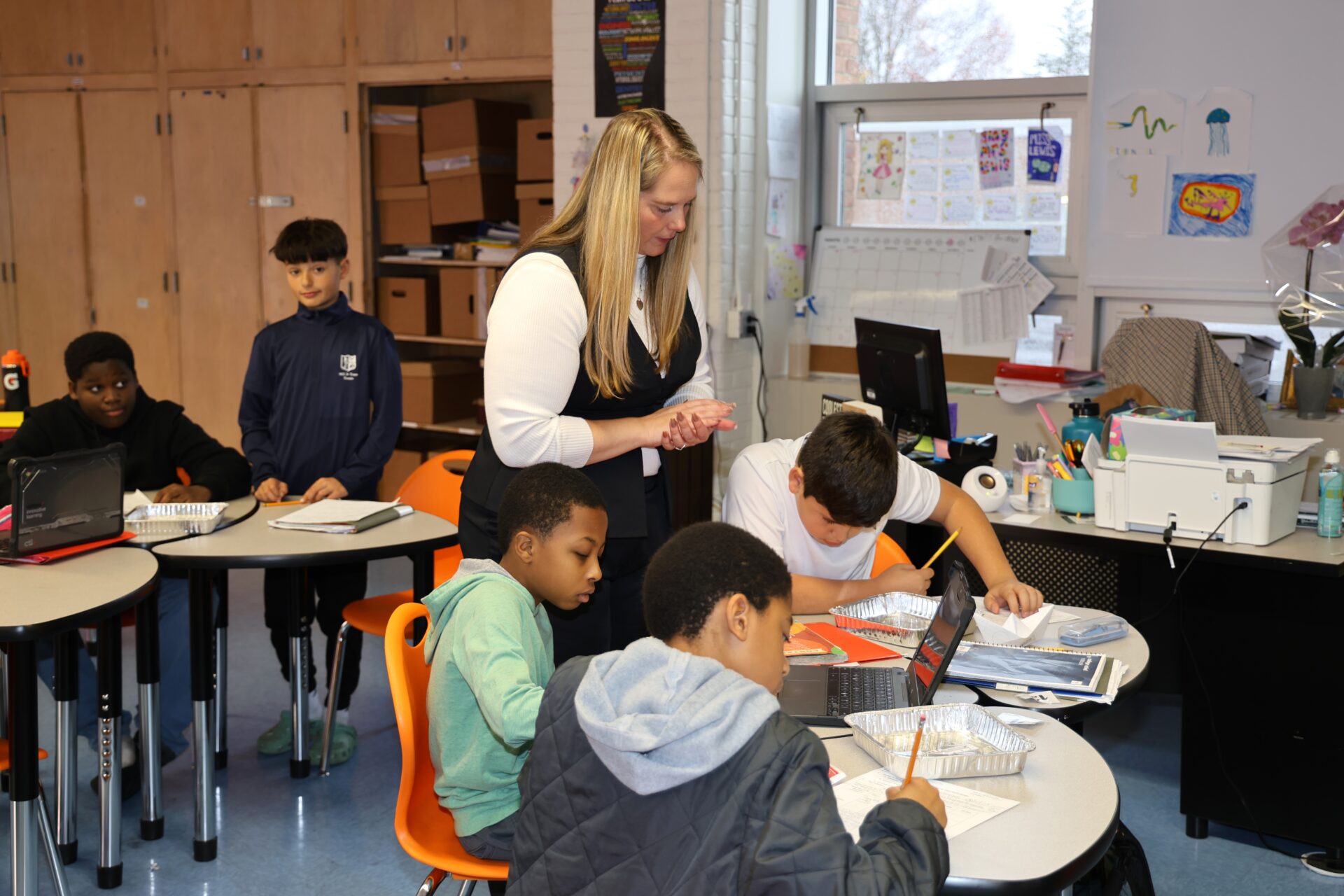
A teacher at Jefferson Marine Science Elementary School leads her students in thinking critically about a water lesson.
Another important piece of keeping it simple is finding something to take off of teachers’ plates. With digital portfolios shared directly with parents and caregivers, teachers no longer needed to write weekly newsletters. In fact, these teachers found that parents were able to see what their children were doing right away and ask their children about school activities. At student conference time, the parents were already familiar with the work their children were doing.
The teachers we talked to were enthusiastic about the portfolio work and were so reflective about how they wanted to improve. Two big points of reflection were (1) giving students the freedom to select their own artifacts and (2) asking students how the work they are submitting connects to the Portrait competencies.
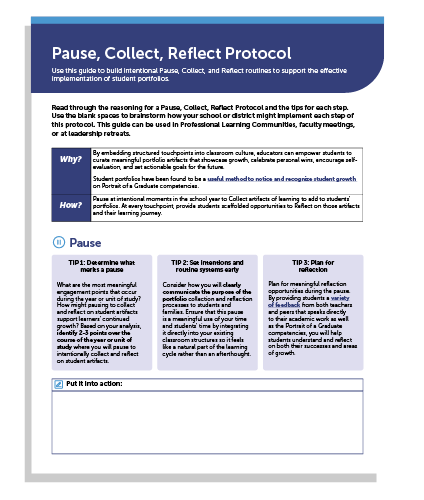
Use this Pause, Collect, Reflect Protocol guide to build intentional Pause, Collect, and Reflect routines to support the effective implementation of student portfolios.
One of the teachers we spoke to was in her first five years of teaching and admitted she felt the need to control students’ portfolio submissions. She reflected that while the processes she created offered important structure to the portfolios, students’ ownership would increase if they could add their own artifacts. She shared that she wants to “let them take the reins” and choose for themselves what items to include in their portfolios. We heard the same thing from the students. Moving forward one recommendation will be that in addition to required portfolio artifacts, students select at least one artifact they think should be included.
Another experienced teacher shared that while her students had gotten very proficient at adding artifacts to their digital portfolios, their reflections were somewhat cursory. She realized that while students had a great deal of independence and skill interacting with the digital portfolio tool, she wanted to strengthen their ability to connect their artifact to their learning and growth. As a result, we are developing reflection protocols that teachers can use with students when submitting to their portfolios that teachers can use, adapt, or modify.
We are listening to our teachers. We will continue to explore how student portfolios can support assessing competencies in our Portrait of a Graduate by working with teacher leaders that are willing to try out portfolios; providing these teachers with simple tools and processes for collecting and reflecting on students’ work; and encouraging portfolio development that centers student ownership and self-reflection.

