
How Districts Can Optimize Tech Infrastructure to Improve Graduation Rates: A New Playbook for Student Success

Key Ideas
- Educators spend an unsustainable amount of time manually tracking down fragmented information, ultimately resulting in disconnected data burying critical early warning signs that indicate when a student is at-risk.
- Transitioning from isolated technology solutions to an integrated, custom data ecosystem allows schools and districts to dramatically cut the time lag between a student needing help and receiving it.
- The Student Success Systems Playbook provides an interactive blueprint to bridge existing infrastructure gaps, empowering schools and districts to optimize their current technology and human capital to deliver the supports students need in time for them to graduate on-time and thrive in their postsecondary endeavors.
Every year, about 500,000 students don’t graduate on time. The consequences—including lower lifetime earnings, fewer possible career pathways, and reduced civic participation—can follow them for decades.
By the time chronic absenteeism presents itself and on-time graduation is at risk, schools and districts have missed critical early warnings that lie buried in often noisy student data. Meanwhile, the educators who might have caught these warnings earlier are overwhelmed: About 50% of teachers cite administrative tasks, like manually transferring student data, as their top source of job stress, driving more than three-quarters of teachers to consider quitting their profession. The onus of administrative tasks is a systems problem: The tension between the urgent need for actionable data and the crushing burden of acting on it lies in the ineffective, outmoded, and needlessly complex data systems that schools and districts often employ. To identify early warning signs, teams need an efficient system that delivers holistic student context at the right time, driving interventions and ensuring students’ continued success.
The technical systems that support student success are too often an ad-hoc compilation of tools pieced together with digital tape and glue. Driven by immediate need instead of systemwide vision, districts and schools select individual tools for isolated tasks. In practice, this means a single platform takes attendance, another pushes family notifications, a third stores counselors’ notes, and a fourth tracks intervention implementation and impact, among an ecosystem of many other tools. This fragmented approach creates an overwhelming strain on school and district staff, directly contributing to systemic burnout, and prevents them from seeing a holistic picture of what supports are needed. But the real cost is felt by students. The result: School staff are unable to access the data they need to identify at-risk students, while students are unable to access the support they need to succeed.
Designing Tech Ecosystems for Student Success
High-quality design of student success systems addresses these multifaceted challenges. These systems are human-centered, evidence-based frameworks that unite school and district staff in supporting each student in graduating on time, prepared to flourish in their next steps (The GRAD Partnership). The most powerful systems seamlessly integrate technical capabilities across multiple technology solutions, layering in multi-tiered systems of support (MTSS), to drive actionable data cycles. Rather than replacing human judgment, a well-configured system:
- Flags risk early: Identifies at-risk students to prevent chronic absenteeism before it begins;
- Uncovers root causes: Links attendance, behavior, and course grades with students’ self-reported sense of agency, belonging, and connectedness to understand why a student is struggling; and
- Streamlines interventions: Connects staff with evidence-based interventions that can be seamlessly assigned, monitored for implementation, and evaluated for impact.
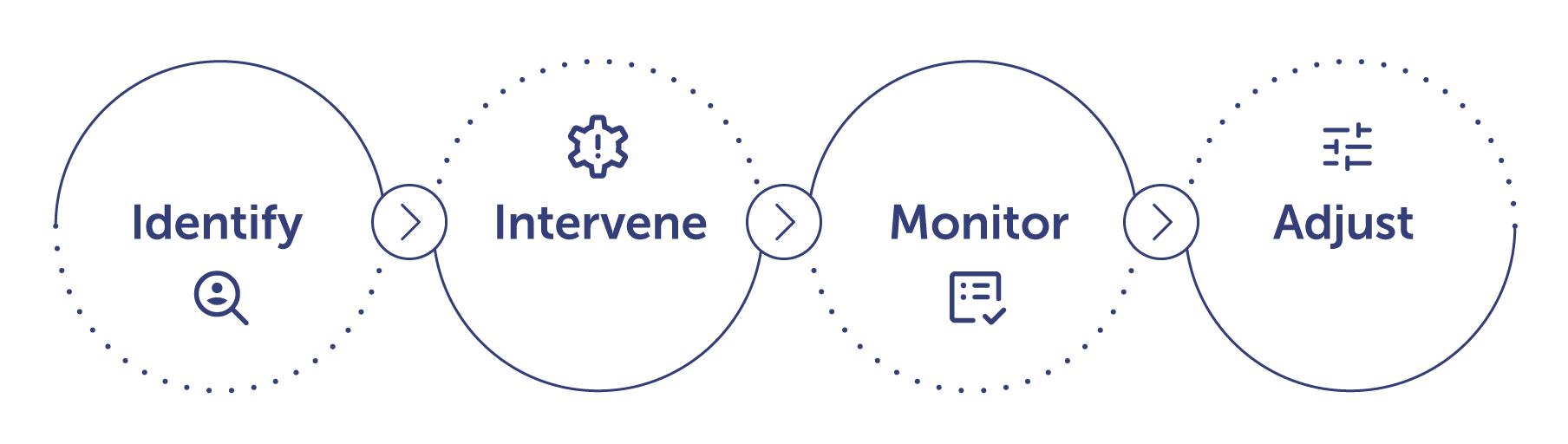
Mutual understanding between students, school and district staff, and families is the heart of this work. Yet, without intentionally designed systems, they are forced to use limited, outdated, and fragmented data and therefore rely on guesswork to pinpoint root causes. A well-designed student success system establishes the seamless flow of information so staff, students, and families can build mutual understanding to provide students the correct help exactly when they need it.
Introducing the Student Success Systems Playbook
In collaboration with the GRAD Partnership, CORE Districts, Network for College Success (NCS), and Preva Group, and in partnership with technical solution providers and district and school teams, Digital Promise developed the Student Success Systems Playbook. The playbook is designed to support schools and districts with creating their own student success system, provide critical directions on how to deploy their system effectively, and share recommendations for how staff might be able to leverage AI to increase capacity.
This calendar-based, interactive, online tool centers human expertise and relationships while optimizing the underlying technology. The playbook explicitly maps out the critical roles of staff, students, and families throughout the key milestones across a school year and how technology can support those roles. By identifying technical capabilities that can offload routine and administrative burdens, the playbook frees up what teams need most: time to collaborate and build relationships with students and caregivers.
The playbook organizes workflows—or plays—across three distinct stages of the academic year:
Leverage the Playbook to Design Your District’s Student Success System
The Student Success Playbook is an interactive, tool-agnostic resource designed to help school and district teams maximize and optimize technology they already have in place, rather than forcing them to adopt new applications. Whether used independently by a school or district team or in tandem with technical assistance providers, the playbook supports teams in designing comprehensive student profiles, mapping out data collection timelines over the school year, and establishing intervention assignment, monitoring, and evaluation protocols to offer the support each student needs to thrive.
The playbook delivers a robust set of interactive resources for each topic:
- A responsive technical infrastructure checklist. This tool helps teams evaluate their current software capabilities and provides real-world workarounds where existing tools fall short, pre-drafted questions to get clarity on technical functionality from district or provider teams where functionality is unclear, and suggestions to further optimize technical systems when tools meet the described functionality.
- Workflow plays. Clearly defined human and technical roles throughout the workflow, including interactive decision points, to provide teams with the most useful information to support their development of comprehensive, technically optimized student success initiatives.
- Examples in practice. Case studies that document innovative district approaches as well as technical capabilities for products on the market.
The playbook is designed to meet teams exactly where they are, allowing them to jump into urgent priorities immediately while maintaining a comprehensive blueprint for year-long systemic health. By intentionally shaping the district’s technical pipelines, the playbook ensures that data flows smoothly across every touchpoint, transforming technology from an administrative barrier into a catalyst for student success.
Want to know more about efforts to improve on-track graduation with emerging technologies?
- Dive deeper in the Student Success Systems Playbook
- Designing Student Success Systems Intentionally: Case Study
- Discover ideas through Digital Promise’s District-Led Innovation Showcase
- Explore the GRAD Partnership’s Student Success Systems Approach
- Consider ideas shared in Kris Hagel’s Build Product Our Agents Can Use