

For years, the learning sciences have told us what makes learning stick. Students learn best when they build knowledge through their own action and choice, when they see their work connect to something real, and when they have room to follow their curiosity. Digital Promise’s Powerful Learning Framework names this directly: learning that fosters agency, purpose, and curiosity through connection to ideas, self, people, and place. These principles are well established and supported by decades of research on how students learn.
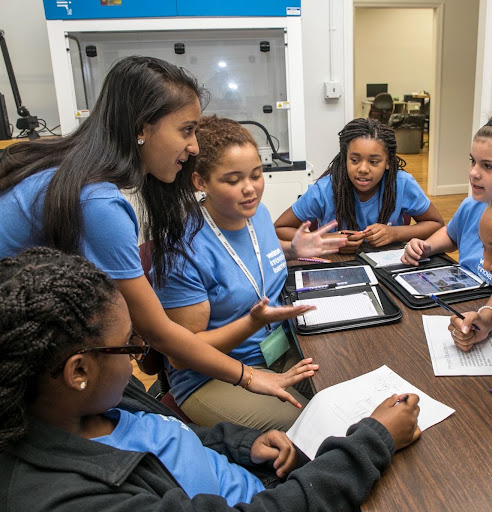
Students at Shenandoah Middle School in Miami analyze plants and insects they’ve captured on digital devices to transform them into artwork. With the help of technology, these students are building key STEM skills.
And yet most students do not experience Powerful Learning consistently because it often relies on individuals rather than coordinated support. For example, one teacher might create meaningful opportunities for student-led inquiry, but without shared practices to sustain it, the practice disappears when the teacher does. Students need coherent opportunities for Powerful Learning, and this happens at the systems level. Enacting change at this level ensures the appropriate conditions, strategies, and tools are in place to reach every classroom, especially those serving the learners who need it most.
Systems-level conditions are the structures, policies, and norms that shape what learning experiences are possible. Strategies are the deliberate actions leaders and educators take to support those experiences. Tools are the curricula, resources, and technologies a system selects and supports to put those strategies into practice.
Powerful Learning requires support across the education system so that agency, purpose, and curiosity can become part of students’ everyday learning experiences. Districts and schools shape these opportunities through decisions about instructional time, assessment, professional learning, and technology. They can protect time for teachers to examine student work together, design assessments that recognize students’ reasoning, and evaluate technologies based on how they deepen thinking. When these decisions align, educators have the support to make Powerful Learning a consistent experience across classrooms.
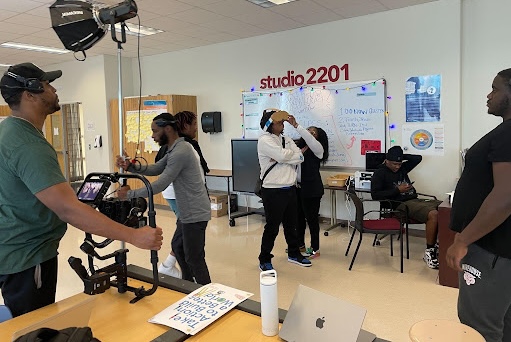
Students using a VR headset at Benjamin E. Mays High School in Atlanta, Georgia.
The Powerful Learning paper illustrates this through an example district led by Superintendent Shelton. Her team redesigned professional learning time around sustained, school-based inquiry, revised assessments to recognize skills and dispositions alongside content mastery, and made sure the highest-need schools had coaching and planning time. These changes empowered students to take charge of their learning, as demonstrated by a fourth grader who presented findings from a study she had designed herself.
Shelton’s approach brought the conditions, strategies, and tools of Powerful Learning into alignment. Conditions included protected planning time, access to coaching, and trusting professional relationships. Strategies put those supports to work through sustained teacher inquiry and assessments that recognized skills and dispositions alongside content knowledge. Tools, including curriculum materials and technologies, supported these goals when educators had the time and guidance to use them purposefully. Together, these components connected the district’s vision to classroom practice, giving teachers room to support students as they pursued questions, directed their learning, and made meaningful contributions.
The good news is that this doesn’t require starting from nothing. Most districts already have real assets to build on: teachers who’ve quietly figured out what works, instructional coaches, partnerships, existing course sequences. What’s usually missing is coherence–a shared, deliberate answer to what well-designed learning actually requires.
A district that wants to scale Powerful Learning needs a process that defines goals, assesses strengths and gaps, engages teams across departments and grade levels, and uses evidence to continuously improve.
States have a parallel job, and it’s one that districts can’t do for themselves. Standards and assessments still largely reward speed and coverage over reasoning and reflection, which quietly punishes the very instructional moves that powerful learning depends on. Without state-level movement on what gets measured and who gets trained, district-level coherence hits a ceiling fast.
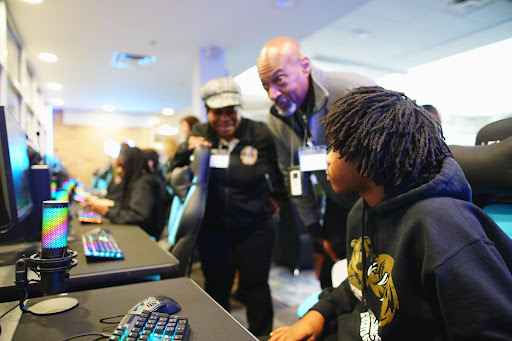
At a ribbon cutting ceremony for an HP AI Studio at Ypsilanti Community Schools, a student shares a website he was developing for his own small business with attendees.
The technology sitting in the room, whether it’s a set of manipulatives, a learning platform, or the latest AI tool, doesn’t change any of this math. It’s a tool. Like every tool before it, it will deepen learning where the underlying conditions already support agency and curiosity, and it will just as easily automate their absence where those conditions don’t exist. That’s why Digital Promise’s research calls for technology that is evidence-based, learner-centered, and skill-building, and for systems that choose and implement it with the same care.
Classrooms will keep being the unit where Powerful Learning is either created or missed, moment by moment. But the conditions for it get built above the classroom: in schools that redesign how professional time is spent, in districts that treat coherent pathway design as a real deliverable rather than an aspiration, in states that align standards and assessments to what they value, and in the shared, cross-district learning that keeps any one place from having to solve this alone.
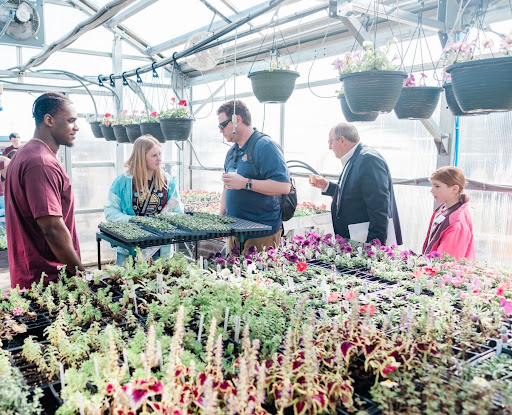
Members of the League of Innovative Schools attending the League’s annual convening visited California Area School District (Pennsylvania) and saw outdoor classrooms, including this greenhouse. Visitors noted how the district has used its unique environment to enrich the learning experiences of its students.
Public education has never lacked exceptional classrooms. What it has lacked is shared, deliberate effort to make the conditions behind them the rule instead of the exception.
Educators, system leaders, technology developers, and policymakers: We invite you to learn, question, and design alongside us. Start with the full Powerful Learning paper and use it with your team to examine what your system’s structures make possible today.
This post reflects the work of the Powerful Learning team and colleagues across Digital Promise. Authors Sharin Jacob and Kelly McNeil drafted it with support from an AI assistant, and reviewed, fact-checked, and approved the final version. We take full responsibility for its content.

