


AI literacy has emerged as one of the most essential skillsets for K-12 learners as generative AI and other emerging technologies are increasingly leveraged in and out of school. Defined broadly, AI literacy comprises the knowledge and skills that enable people to critically understand, evaluate, and use AI systems and tools to safely and effectively participate in an increasingly digital world. States across the nation are moving to integrate AI Literacy through computer science standards, Portrait of a Graduate, and subject area learning.
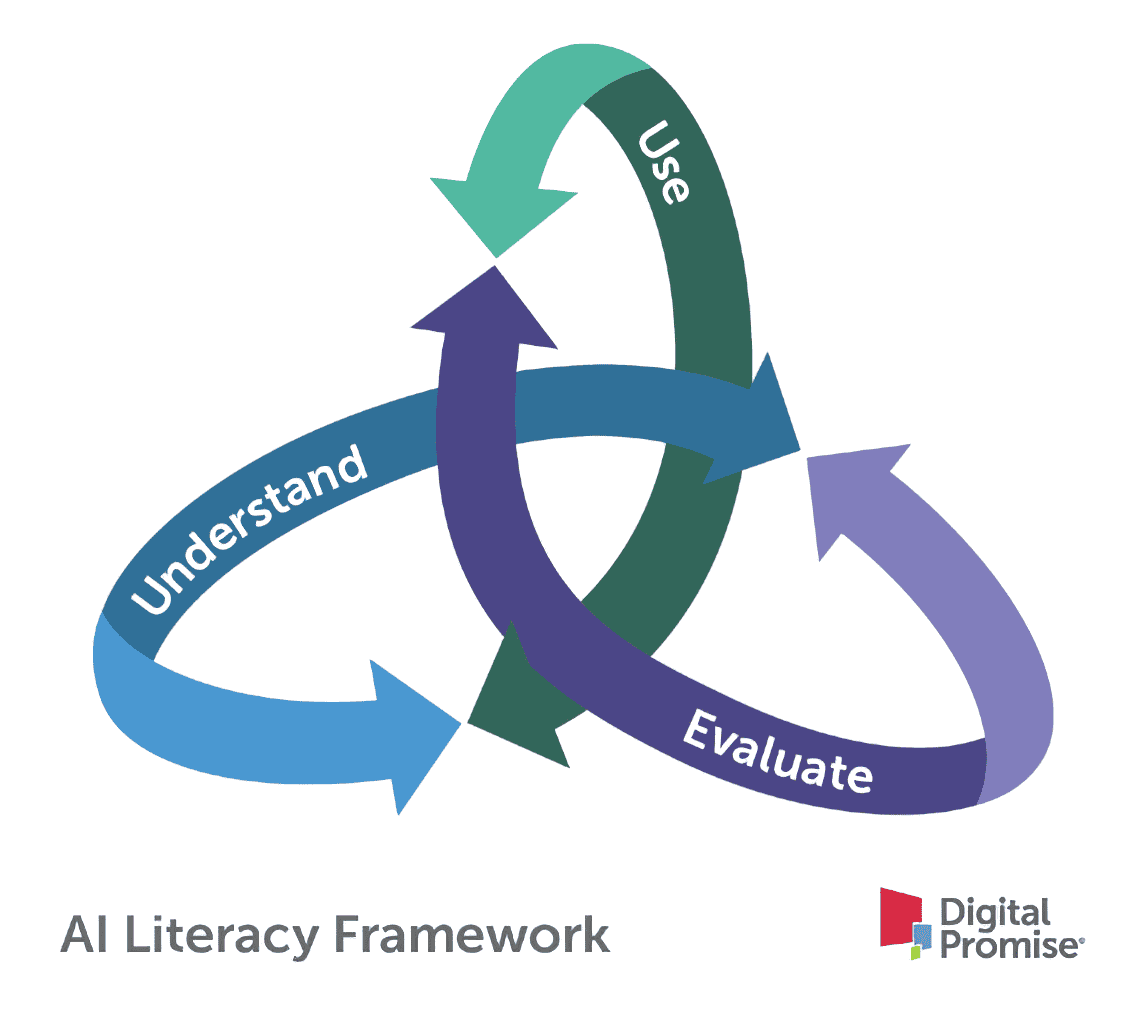
The education field has responded with a plethora of frameworks to demystify AI literacy. Digital Promise released a framework in June 2024 which emphasizes technical ideas to understand emerging technologies, such as data science and machine learning, and also socio-technical skills to evaluate emerging technologies, such as ethics, bias, power, human judgment, and the societal impacts of AI.
However, there is a need for clarity that goes beyond frameworks. Educators are looking for actionable resources that they can directly leverage in teaching and learning. They are asking, What should an AI literate person know and be able to do? And even more specifically: What should they know and do in 4th grade math, 8th grade English, or 11th grade science? How can these skills be applied across contexts, preparing learners for a life of well being and economic success?
In the coming months, Digital Promise, alongside partners, will be developing resources that educators can more directly apply into teaching and learning. To ensure that these resources are responsive to the needs and opportunities of the field, we conducted a landscape scan of existing AI literacy frameworks. We reviewed 33 AI literacy frameworks and related resources published between 2019 and 2026 from academic research, government resources, nonprofits, industry, and prior literature reviews. We examined how they defined AI literacy, what kinds of competencies they emphasized, and what they expected learners to do with AI. This landscape scan yielded the following key insights and opportunities.
The landscape scan revealed that AI literacy often includes a strong emphasis on socio-technical competencies. Very few frameworks focused only on technical skills, with most emphasizing to some extent critical thinking about how AI affects people and society, such as when it can be trusted, where it could cause harm, and how people should remain responsible for its use. This is in stark contrast to computer science education literature, which has often primarily emphasized coding and understanding how technology works. AI literacy efforts suggest that, instead, for most people, the most important part of AI literacy is not building AI systems but engaging with AI thoughtfully and critically in everyday life. Growing bodies of research do emphasize these technical aspects, and almost all frameworks include some aspects of computational thinking, data science, or machine learning, which speak to technical competencies of AI literacy. However, less work connects technical and socio-technical competencies in elaborate ways. It often remains unclear how deeply learners should understand these topics. Opportunity: We need to preserve socio-technical aspects of AI literacy, and there is an opportunity to better connect socio-technical competencies and technical skills.
Currently, we see a lack of guidance that provides clarity by age or grade. Many frameworks name broad competencies for K-12 or even broader populations, but they do not clearly explain how such competencies look for younger children versus adolescents or adult learners. This is worth exploring because especially technical ideas (e.g., probability, abstraction) and ways of social reasoning (e.g., ethical considerations) need to be contextualized for the age of the learners at hand. Opportunity: There is a need for more age specific AI literacy guidance so that resources can be designed to be developmentally appropriate for learners’ age and context.
We also saw that AI literacy, when it comes to learning processes and application, is enhanced by knowledge beyond AI-specific content, including leadership, ethical reasoning, contextual thinking, imagination, interpersonal collaboration, and metacognition. In other words, AI literacy is best gained and put into application when one is able to leverage good judgment, navigate uncertainty, work well with others, and be aware of their own understanding and use of AI. Opportunity: AI literacy learning experiences can explicitly support development of complementary skills and knowledge.
Digital Promise, alongside partners, will be co-designing AI literacy resources with learners and educators, ensuring these tools are useful and adaptable in K-12 learning environments. These resources will empower educators to support learning experiences that equip learners to participate thoughtfully, critically, and responsibly in a world shaped by interactions with AI.
Want to know more about AI literacy?

