

How can edtech developers design classroom products that address real needs of students and teachers? EdLight CEO and Founder Teryn Thomas shared how co-designing with these stakeholders through the Engagement Collaborative for Research & Equity (ENCORE) has shaped her approach in doing just that. As a former educator and school founder, Teryn discovered that student work consistently held the answers teachers were looking for but they had little time to examine it closely.
Funded by the Gates Foundation, ENCORE connects product developers with educators and students to co-develop edtech tools together through an iterative, two-year, rapid-cycle testing process. The value of co-design is to ensure that these tools are practically addressing actual needs of these stakeholders. ENCORE provides the space for them to produce knowledge and shape the edtech market.
Teryn explains, “ENCORE shifted my thinking on student input. Before, getting their opinions felt like a barrier… but seeing students advocate for themselves changed that for me.”
The shift started when EdLight tested their prototype with students at Valley View School District (VVSD) with three levels of AI help (heavy, intermediate, and minimal). Students with heavy AI help became frustrated, complaining, “I actually want to do my own work.” These students did not want AI to do the heavy lifting for them, they wanted to learn—going against a public fear that students are skipping actual thinking and over relying on AI.
“Students want to learn, not have AI do the work for them,” Teryn reflects.
When the prototype provided erroneous outputs, students treated this as an opportunity to “give the AI more work” to improve its algorithm. One student became very motivated to upload work so that the AI could become better for students with disabilities. This enthusiasm inspired the EdLight team to focus on improving accessibility design for students with individualized education programs (IEPs)—a priority that shifted after student feedback. Their product currently reads student work and updates learning goals. Their next step is to improve the design layer. ENCORE created a space for developers to learn from end users on how to innovate and improve their tool.
“Codesign requires letting go of your ideas when real users interact with the product,” reflects Teryn on developing product market fit. “I was initially resistant, but after speaking with a mentor, I let it go. The less I forced it, the more I found joy in the process.”
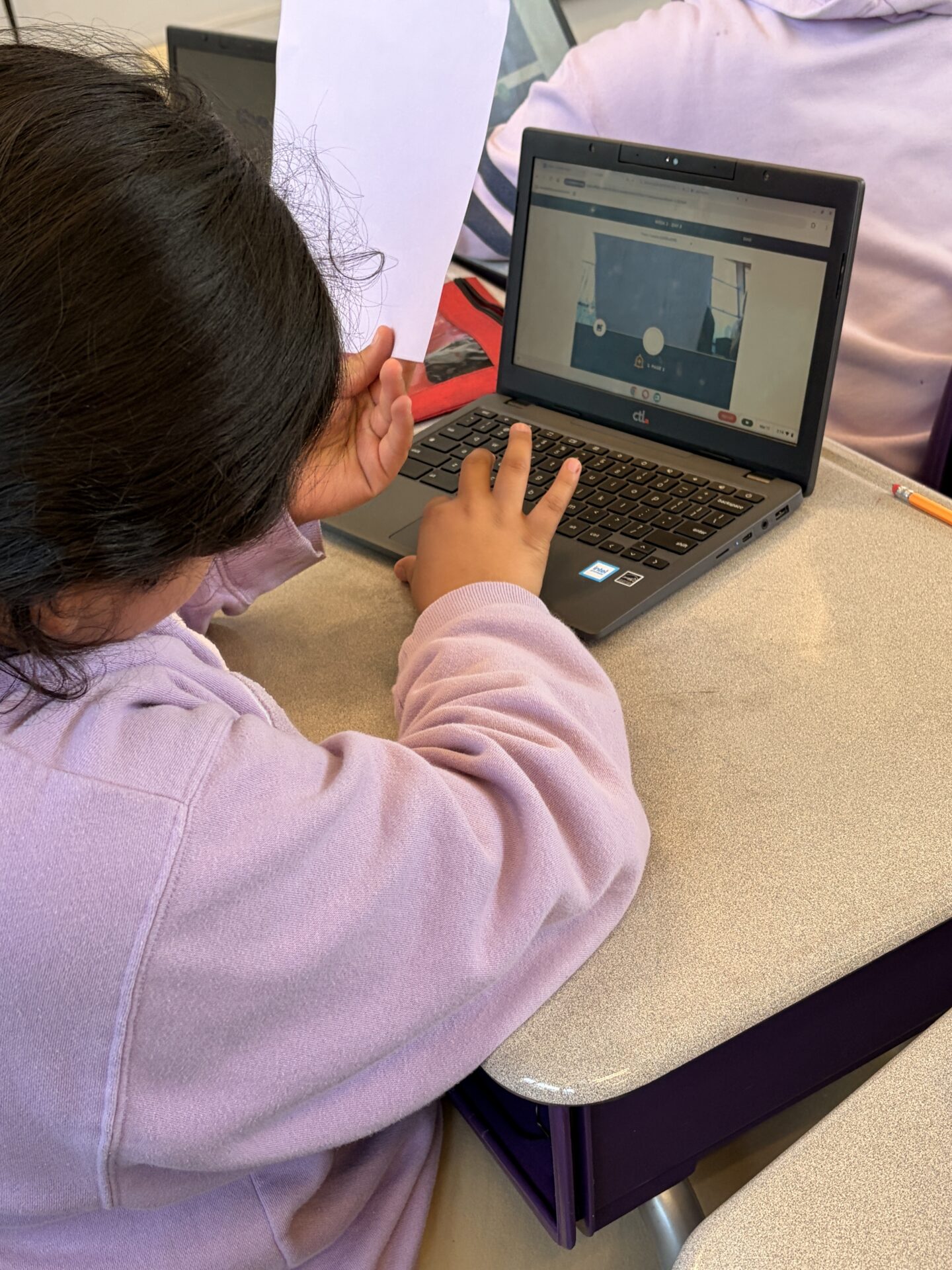
A student interacts with EdLight during a class math exercise. Photo courtesy of EdLight.
Teachers used the Automated Grader feature the most across all phases of testing, especially AI Scoring for student work analysis and support. A teacher shared, “It’s not feasible to formatively assess every student every day without it.” By the end of rapid cycle testing, 60 percent of participating teachers indicated that EdLight provided moderate to strong support for analyzing student data.
While the rapid cycle testing of three features throughout the school year allowed for iterative product improvements, the process of adapting to teachers’ needs also caused some tension. Having to relearn the system, even when the changes had been requested by them, made some teachers resistant to use the product because of the additional time investment. One teacher remarked, “It’s January and we don’t want anything to change.” Despite such reactions Tiffany Forth, VVSD’s Coordinator of 6-12 Math & Science, stated, “My colleagues definitely felt seen and heard. [This was] an incredibly enriching experience for our district.”
Over time, the EdLight team figured out a system for handling feedback: tally every request to avoid over-pivoting on any one voice. Teryn listened for emotion-laden words, such as “That was frustrating” and “I loved that” as signals. Her team learned to hold off on solutions until the underlying pain point is clear and understood.
Finally, Teryn credits ENCORE for creating a cohort of edtech product developers who engage in partnerships across organizations. Teryn said, “Hoarding information raises the floor for no one.” Bringing teams like these together through learning sessions and bi-annual convenings pools brilliant minds and their collective knowledge to advance teacher and student outcomes.
For Teryn, exposure to their industry peers is yet another benefit of participating in ENCORE in considering multiple perspectives to continue broadening their vision. Smart product developers understand that co-designing tools in real time with stakeholders is how everybody wins and students succeed.
ENCORE is part of the AIMS Collaboratory, a network dedicated to advancing equity-focused, evidence-based solutions in math education.
Want to learn more about ENCORE and co-design?

