AI literacy is the knowledge and skills that enable humans to critically understand, evaluate, and use AI systems and tools to safely and ethically participate in an increasingly digital world.
As artificial intelligence (AI) becomes increasingly prevalent in our daily lives and educational settings, it is imperative to equip learners, educators, and leaders with the necessary skills and knowledge to navigate this emerging technology responsibly. Our AI Literacy Framework (depicted below) consists of three interconnected Modes of Engagement: Understand, Evaluate, and Use. The framework emphasizes that understanding and evaluating AI are critical to making informed decisions about if and how to use AI in learning environments.
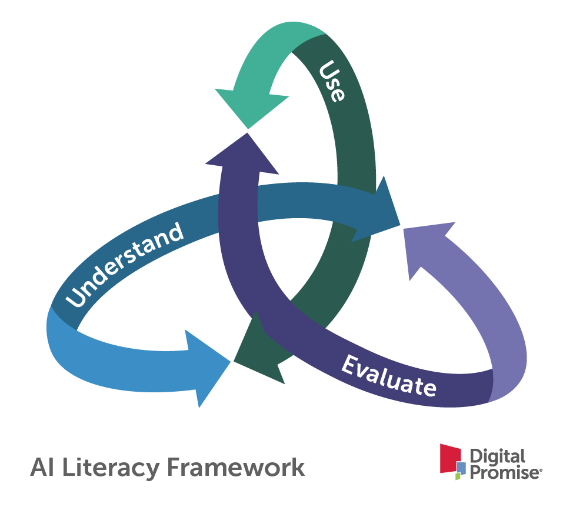
Figure 1. AI Literacy Framework includes three components: Understand, Evaluate, and Use
At Digital Promise, we are applying this framework to enable all who participate in educational settings to leverage AI tools for powerful learning. Our six AI literacy practices, which are actionable skills that learners can demonstrate, define how users can understand and evaluate AI-enabled tools and how educators can support AI literacy development.
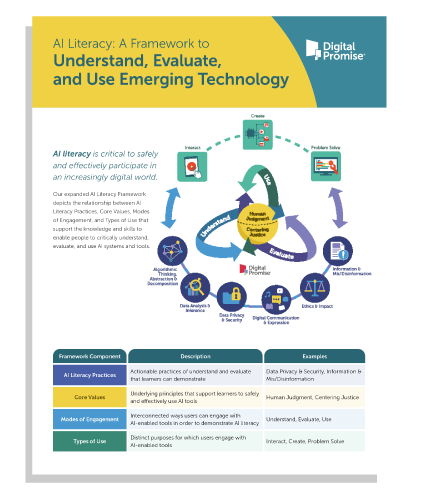
Our expanded AI Literacy Framework depicts the relationship between AI Literacy Practices, Core Values, Modes of Engagement, and Types of Use. Below is a table description of each component.
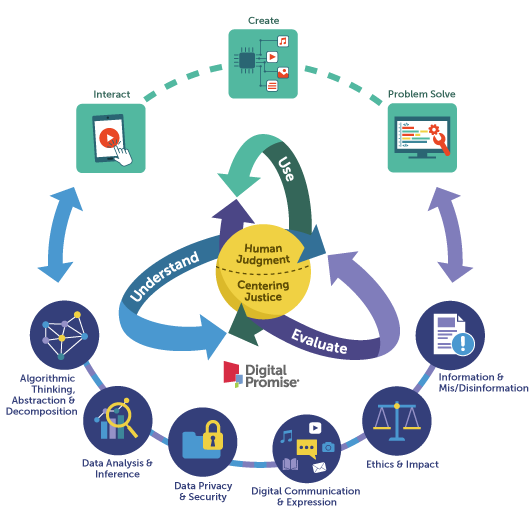
In the center of the expanded framework image is a 3D triangular diagram with three bidirectional arrows. The bottom left arrow is blue and labeled ‘understand’, the bottom right arrow is purple and labeled ‘evaluate’, and the top arrow is green and oriented vertically, labeled ‘use’. At the center of the three bidirectional arrows is a yellow sphere with the text "Human Judgment" on the top half and "Centering Justice" on the bottom half. Surrounding the sphere and arrows are icons arranged in a circle formation. The top three icons correlate to types of ‘use’ and have a green background, connected with a green dotted line. The icons represent ‘interact,’ ‘create,’ and ‘problem solve.’ The bottom six icons represent AI literacy practices for ‘understand’ and ‘evaluate’ with an indigo background, connected with an alternating blue and purple dashed line. The icons represent ‘data privacy & security,’ ‘ethic & impact,’ ‘digital communication & expression,’ ‘information & mis/disinformation,’ ‘data analysis & inference,’ and ‘algorithmic thinking, abstraction, & decomposition.’ The top three green icons and the bottom six indigo icons are connected with a bidirectional blue arrow on the left and a bidirectional purple arrow on the right.
| Framework Component | Description | Examples |
|---|---|---|
|
AI Literacy Practices |
Actionable practices of understand and evaluate that learners can demonstrate |
Data Privacy & Security, Information & Mis/Disinformation |
|
Core Values |
Underlying principles that support learners to safely and effectively use AI tools |
Human Judgment, Centering Justice |
|
Modes of Engagement |
Interconnected ways users can engage with AI-enabled tools in order to demonstrate AI literacy |
Understand, Evaluate, Use |
|
Types of Use |
Distinct purposes for which users engage with AI-enabled tools |
Interact, Create, Problem Solve |
| Framework Component |
AI Literacy Practices |
|---|---|
| Description |
Actionable practices of understand and evaluate that learners can demonstrate |
| Examples |
Data Privacy & Security, Information & Mis/Disinformation |
| Framework Component |
Core Values |
| Description |
Underlying principles that support learners to safely and effectively use AI tools |
| Examples |
Human Judgment, Centering Justice |
| Framework Component |
Modes of Engagement |
| Description |
Interconnected ways users can engage with AI-enabled tools in order to demonstrate AI literacy |
| Examples |
Understand, Evaluate, Use |
| Framework Component |
Types of Use |
| Description |
Distinct purposes for which users engage with AI-enabled tools |
| Examples |
Interact, Create, Problem Solve |
Table 1. Components of the AI Literacy Framework