
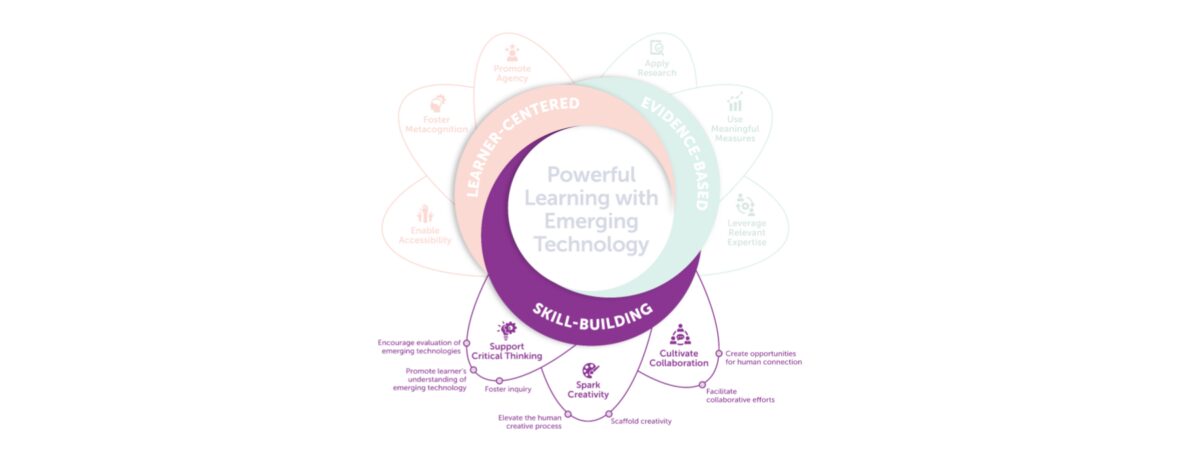


As AI changes our access to information and knowledge, teaching uniquely human skills like critical thinking, creativity, and collaboration become even more vital. These durable skills retain their value in a world where answers are immediately accessible. However, fostering those skills with the help of AI tools requires intentional design choices by developers and educators to avoid diminishing the necessary processes for their development. How can we redesign our classrooms to prioritize durable skill development with AI tools that build skills, not replace them?
In our recent webinar, we explored strategies to answer this question with Roberta Lenger Kang, executive director of the Center for the Professional Education of Teachers at Teachers College, Columbia University; ‘Joba Adisa, postdoctoral fellow with the Stanford Institute for Human-Centered AI; Kali Peracchia, AI instructional specialist at Denver Public Schools; and Matt Miller, CEO and co-founder of OKO Labs.
While AI is good at presenting learners with information, it’s vital that they have the critical thinking skills to understand, interpret, and evaluate that information. By designing AI-enabled tools that move beyond problem-solving to encouraging further inquiry, developers can give learners the chance to train that skill. Tools that scaffold background knowledge, set context for exploration, or prompt users to explore multiple perspectives allow learners to practice their own thinking and move towards self-directed learning.
In the webinar, Adisa discussed the difference between task completion and mastery. When working with AI tools, he said, there is evidence of short term gains in task completion, but when access to AI is removed, those gains disappear. In that case, task mastery—and the critical thinking to achieve it—becomes vital for learner progression from novice to expert. AI literacy is a key factor in that progression.
As Adisa said, “[It’s necessary to include] tools or concepts within the curriculum that help students develop that critical perspective about whether the AI is correct.”
To illustrate the global context that can promote critical thinking, Peracchia spoke about the need for students to understand that “AI is bigger than just the tools in our classroom, it’s the socio-technical systems that are surrounding” them and the importance of learners navigating those systems with their own agency. In an example shared, a first grader in her district created an anti-littering campaign with the help of AI after exploring the issue via student-lead inquiry.
To build a learner’s creative skills, human thinking must remain central to creative tasks. AI-enabled tools can support that creative thinking by providing scaffolds, automating repetitive tasks, or organizing scattered data. But when users are able to offload the cognitive effort of creative thinking, it can prevent the productive struggle that produces innovative problem solving. Developers must consider how quickly their tools provide solutions or produce results to avoid inhibiting users creativity.
Kang described the cognitive offloading situation as “the teacher using an AI tool to create the task, and a student using an AI tool to complete the task, and the teacher using an AI tool to grade the task. No one’s really learning anything.”
Instead, she emphasized that using AI to enhance learning means focusing on instructional objectives and what students should know and be able to do as a result of learning experiences. This requires learners to be the ones doing the “dreaming or imagining,” not AI tools.
Learning is a social process in which human relationships are a key component. Technology cannot replace those relationships, but it can create opportunities that support collaboration. Taking steps like encouraging users to interact with an LLM on a shared device to create conversation or promoting interaction on a tool’s platform can provide learners with the chance to develop collaborative skills. AI tools can also provide helpful feedback for educators by monitoring talk time and providing data-driven recommendations for human facilitators. However, ultimately, social regulation skills must be driven by interaction between humans, not solely mediated through technology.
From a developer’s perspective, Miller discussed OKO’s approach of “not leveraging AI to just get learners to engage better with the AI, but to leverage AI to get learners to engage with one another.”
In large classrooms, it’s extremely difficult to facilitate high-quality small group work for a single teacher; OKO has leaned into supporting the educator’s ability to facilitate small group discussions and enhanced their ability to understand the content of those discussions without needing to be present at each one. According to Miller, by providing reports on both the subject matter concepts and the interpersonal interactions in small group discussions, OKO can deliver guidance and coaching for educators to provide effective tools for collaboration.

