
In 2024, the Collaborative launched the Five EdTech Quality Indicators (FEQI): a research-grounded framework designed to support strategic procurement and implementation decisions.
In 2026, the EQC launched the EdTech Quality Indicators Guide, a practical resource for education leaders to streamline the ways they leverage third-party validations in their edtech procurement processes.
This guide provides an easy-to-use resource to help leaders at the district level integrate the EdTech Quality Indicators framework into their procurement processes and data governance plans. Use the guide to support intentional decisions, strategic resource allocation, strong implementation, and measurable improvements in student outcomes.
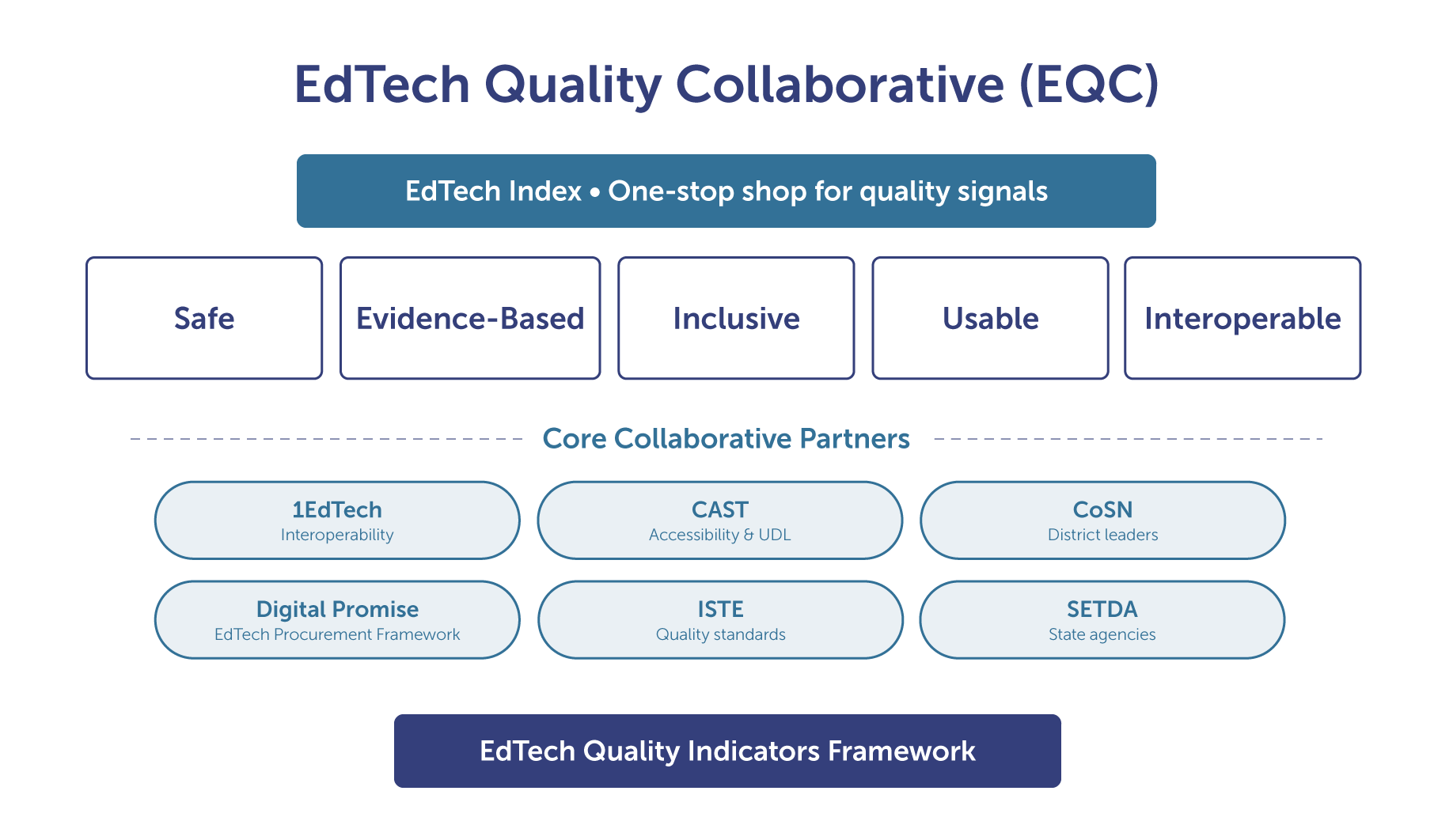
The EdTech Quality Collaborative (EQC) brings together six leading organizations—1EdTech, CAST, CoSN, Digital Promise, ISTE, and SETDA—around an EdTech Index built on five quality indicators: Safe, Evidence-Based, Inclusive, Usable, and Interoperable.
1. SAFE
Edtech products must establish robust data privacy and security measures to protect student and educator data and safeguard against unauthorized access or data breaches. This includes adhering to industry standards and laws to create a secure learning environment and adopting principles of data minimization (only collecting necessary data) and data transparency (users understand which data are collected for what purpose).
2. EVIDENCE-BASED
Edtech product design, implementation, and claims of effectiveness need to be grounded in rigorous research and evidence-based practices as specified by the ESSA Tiers of Evidence. Providers should engage in research-driven design, empirical validation, demonstrated effectiveness, and alignment with established educational standards.
3. INCLUSIVE
Edtech products must prioritize accessibility, inclusivity, and equitable design to ensure they are acceptable to learners from diverse backgrounds and with a broad range of learner variability. This includes ensuring edtech products are accessible for all learners, do not promote existing stereotypes, create new ones, or prevent students from acquiring accurate information because of biased algorithms.
4. USABLE
Edtech products must be designed to be easily usable by educators and students to ensure a seamless digital experience. If the product is not easy to use, it creates an unnecessary barrier and educators and students will struggle to use the tool.
5. INTEROPERABLE
Edtech products must seamlessly connect to other technologies within a school’s digital ecosystem. This is accomplished by adhering to established interoperability standards that ensure secure exchange and allow for the beneficial aggregation of data to inform instruction and personalize learning.
The EdTech Quality Collaborative brings together leading organizations, each contributing distinct expertise to support comprehensive edtech evaluation.




The 5 Edtech Quality Indicators framework is licensed under CC BY-NC-ND 4.0

Together, this work is advancing a more efficient, transparent, accessible, and evidence-informed edtech marketplace.
Sign up to stay informed and get involved.
Let's connect and we'll send you the latest from Digital Promise.